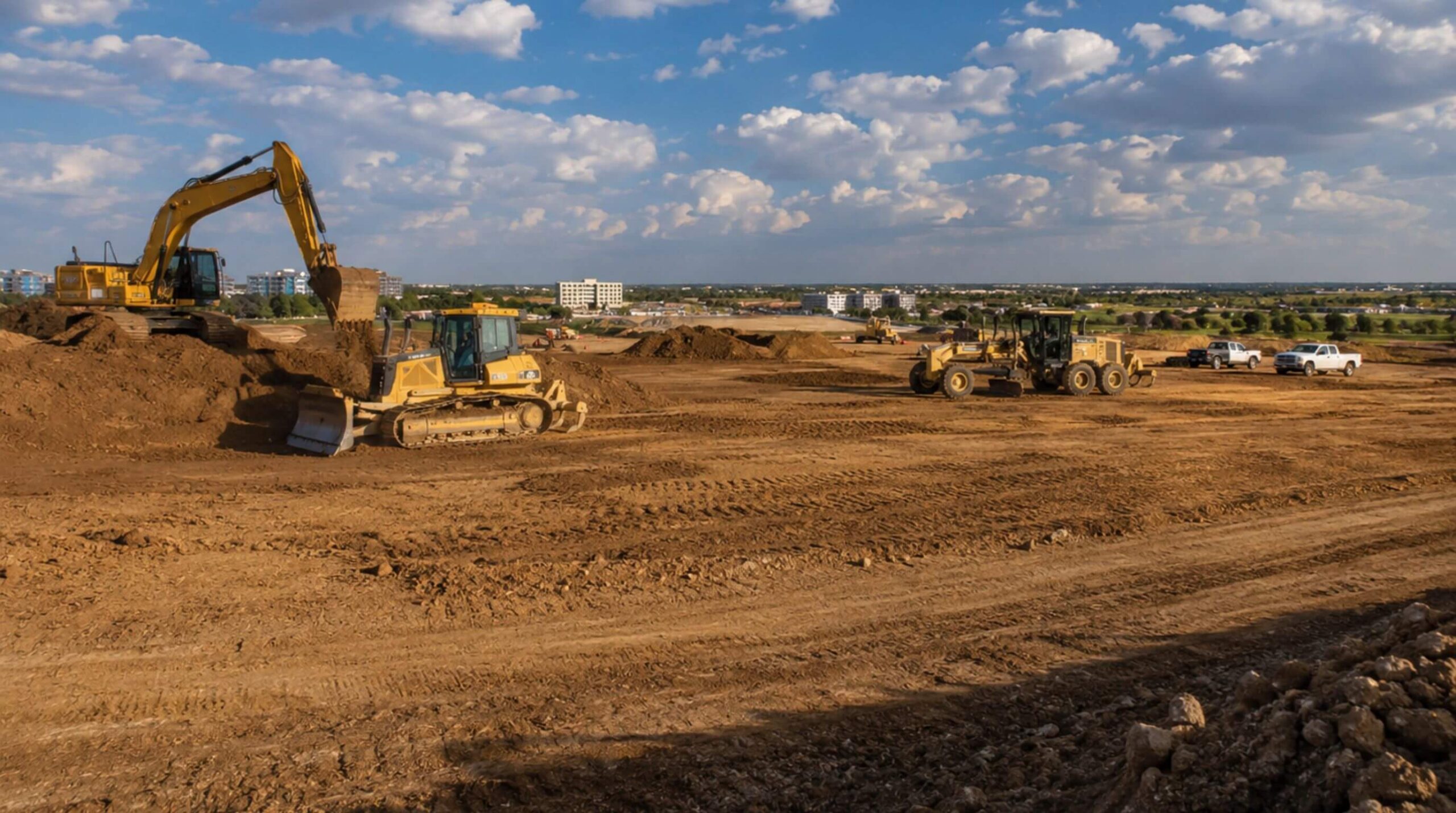

An owner asking about an earthwork contractor usually starts with the company: how long have you been in business, who else have you built for, can I see the insurance. Those are worth asking, and a general contractor evaluating a subcontractor's paper has a longer list of them. They are not the questions that decide what the owner ends up carrying.
Six questions do that. Each one has a document behind it, and the document is what turns an answer into something verifiable. These are the six, in the order they come up on a commercial site, with the rule that gives each one its weight and what a real answer sounds like.
1. The report, and its revision
Which report is the bid priced against, and which revision of it? A geotechnical report is not background reading. It is the standard the fill will be tested against, and it is the document that says what can be reused, what has to come out, what moisture each material is placed at and whether the subgrade needs treatment. Where an investigation involves in-situ testing, laboratory testing or engineering calculations, the code requires that it be conducted by a registered design professional1, and the written report has to carry the boring logs, the soil profiles, the groundwater elevation, the recommendations and the provisions for expansive soil and compacted fill1. Soil materials are classified under ASTM D248712.
The question is about the revision, not the existence. Reports get amended after a boring is added, after a building moves on the plan, after a phase is added to the program. A bid priced against the first issue and a scope built to the third are two different jobs that look identical on a spreadsheet. Ask every bidder to name the report by title, date and revision on the face of the proposal, and ask what changed between the revision they read and the current one. A contractor who cannot answer that has not read it recently enough to be bidding it.
Second part of the same question: is the report addressed to you. Geotechnical reports are prepared for a client, and reliance often runs no further than that client. If the report was commissioned by a previous owner or by a design team on a different deal, ask the engineer for a reliance letter before anyone prices work against it.
2. The name on the stormwater permit
Whose name is on it? This is the question owners most often assume is the contractor's problem, and the permit does not read that way. Under the state construction general permit an operator is a person associated with the construction activity who is either a primary or a secondary operator, and the definitions are specific. A primary operator has on-site operational control over construction plans and specifications, including the ability to modify them, or has day-to-day operational control of the activities necessary to ensure compliance with the stormwater pollution prevention plan3. A secondary operator is the person or entity, in the permit's own words often the property owner, whose control is limited to employing other operators such as a general contractor, or to approving or disapproving changes to the plans and specifications without day-to-day on-site control3.
Three consequences follow, and every one of them lands on the owner. A secondary operator must either prepare its own pollution prevention plan or participate in a shared plan covering the areas where it controls the plans and specifications3. Where there is no primary operator at the site, the secondary operator is defined as the primary operator and has to meet every primary operator requirement3. And an operator is a permittee3, which means the obligations are direct, not delegated by a line in a subcontract.
So the useful version of the question is: who is the primary operator on this job, is that written down, and whose plan am I participating in. On the sites we work, the answer belongs in the contract before the first control goes in the ground, because the permit assigns the role by who actually holds control, not by who volunteered.
3. Who employs the laboratory
Who hires the testing laboratory, and who receives what it finds? Owners often discover late that the laboratory testing their fill was hired by the company placing it. The code does not leave the choice open: the owner or the owner's authorized agent, other than the contractor, employs the approved agencies that provide special inspections and tests4. That single phrase, other than the contractor, is the whole answer to who the laboratory works for.
The reporting requirement is where owners get caught, because the owner is not named in it. Special inspection reports are submitted to the building official and to the registered design professional in responsible charge4. Discrepancies go first to the contractor for correction, and if they are not corrected they go to the building official and the design professional before that phase of work is finished4. Nothing in that chain obliges anyone to copy the owner.
Ask for it, then, in writing: every density and moisture report, every failing test and every retest, delivered to you on the same day it goes to the engineer. We send them that way as a matter of course, and a failing test arrives with what we are doing about it rather than after it has been fixed.
4. Whose citation it is
If a federal inspector walks the site, whose citation is it? An owner with no employees on site can still be on the paper. Federal enforcement policy sorts every employer at a multi-employer worksite into one of four roles, creating, exposing, correcting or controlling, and an employer can hold more than one5. The one that reaches an owner or a construction manager is the controlling employer: an employer with general supervisory authority over the worksite, including the power to correct safety and health violations itself or require others to correct them, and the directive is explicit that control can be established by contract or, absent an express contract provision, by the exercise of control in practice5.
A controlling employer has to exercise reasonable care to prevent and detect violations on the site5. That duty is lighter than the duty an employer owes its own crews, and the policy says so: a controlling employer is not normally expected to inspect as often, or to know the standards and the trade as well, as the contractor it hired5. How often it must look turns on the scale of the project, the nature and pace of the work, and what it knows about the safety history and practices of the company it controls5. Separately, on construction work the prime contractor is never relieved of overall responsibility for compliance with the construction standards for all work under the contract, whatever the prime and its subcontractors arrange between themselves6.
The practical question is therefore two questions. Who is the controlling employer here, and what does the owner's own site conduct say about that. An owner whose representative directs means and methods in the field has assumed a role no indemnity clause gives back.
5. Retainage, and the route a lien takes
What is the owner required to hold back, and how would a lien reach the land? This is the question with the most statute behind it and the least attention paid to it. During the progress of work under an original contract and for thirty days after it is completed, the owner is required to reserve ten percent of the contract price, or ten percent of the value of the work7. If the owner does not, claimants who have complied with the statute have a lien at least to the extent of the amount that should have been reserved7. The reserve is not a negotiating tool. It is the fund the statute expects to be there.
The notice mechanism is the part worth understanding before it arrives in the mail. A claimant who did not contract directly with the owner must send notice, and on a commercial project that notice is due not later than the fifteenth day of the third month after the month in which the labor or materials were provided7. Once notice is received the owner may withhold from payments to the original contractor an amount sufficient to pay the claim7, and must retain the withheld funds until the time for filing a lien affidavit has passed or, if one was filed, until the claim is satisfied or released7. An owner who keeps paying the original contractor after the authority to withhold has arisen, where the claimant then perfects its lien and reduces the claim to judgment, can be reached for those payments7.
The document on the other side of it is the affidavit: a statement of whether all subcontractors, laborers and materialmen have been paid in full, and if not, the amount owed and the name and, where known, the address and telephone number of each one still owed7. Ask for it with the final application for payment, with the unconditional waivers behind it. We send both, and we send the waivers from our own suppliers with them.
6. The turnover packet
What does the owner hold on the day the site is handed over? A graded site looks finished from the moment the last pass is made, which is why the turnover question has to be about paper. Three documents make the difference between a pad that is ready and a pad that is merely at grade.
The first is the record survey, shot on the finished surface and checked against the design model, so the elevations are measured rather than reported. The second is the density and moisture record: the laboratory's moisture-density relationship for each material placed, developed under the state method for subgrade, embankment and backfill soils8 or the equivalent ASTM standard-effort procedure9, with the in-place results measured against it10. The third is the correspondence trail on anything that failed and was reworked, because a pad with no failing tests anywhere in its history is a pad whose testing was too sparse to find one.
Ask for all three as a condition of final payment, and ask for them in a form the next contractor can use. The concrete crew, the paving crew and the building official are each about to rely on this ground, and the record is what lets them.
| Question | The document | A real answer |
|---|---|---|
| Which report, which revision? | The geotechnical report, by title, date and revision1 | Names it on the proposal and says what changed between revisions |
| Whose name is on the stormwater permit? | The permit's operator definitions and the pollution prevention plan3 | Names the primary operator in writing and says whose plan the owner participates in |
| Who employs the laboratory? | The special inspection provisions4 | The owner employs it, and the reports come to the owner the day they are issued |
| Whose citation is it? | The multi-employer citation policy5, and the prime contractor's overall responsibility6 | Identifies who holds general supervisory authority, and what reasonable care looks like here |
| What do I hold back? | Ten percent reserved through the work and for thirty days after7 | Expects the reserve, and hands over the affidavit and waivers with the last invoice |
| What do I hold at turnover? | Record survey, moisture-density record8910, and the rework trail | Delivers all three without being chased, in a usable form |
What we answer before we bid
IRONWILL Earthworks answers all six in writing with the proposal: the report title, date and revision we priced, who we expect to be named primary operator and why, the confirmation that the laboratory is yours and that its reports come to you as they are issued, who holds supervisory authority on the ground and how we document our own inspections, the affidavit and unconditional waivers that come with our final application for payment, and the turnover packet you will be handed. Two of the six are decisions only you can make. The other four we can settle before anyone mobilizes, which is the cheapest moment to settle any of them.
For the documents to request when you are comparing one earthwork contractor against another, our note on how a general contractor evaluates an earthwork contractor covers the corporate paper. For the clauses that decide who carries a surprise in the ground, read what an excavation contract has to say.