

Paving Subgrade Preparation Across Texas and Oklahoma
A pavement is designed against an assumed subgrade. Paving subgrade preparation is the work of making that assumption true on the ground: proof rolling, undercutting, moisture conditioning, chemical treatment with the additive the laboratory selects, and imported flexible base, each layer tested to the specification before the next one goes down. IRONWILL Earthworks prepares the ground under pavement across Texas and Oklahoma, built to whichever of the report and the paving specification is stricter.
Every pavement layer leans on the one below it
Rutting in the wheel paths, alligator cracking that grows a little each summer, a pothole that comes back in the same spot after each patch: these are the pavement reporting what is underneath it. The Federal Highway Administration's pavement geotechnics manual puts it in one sentence: the unbound soil layers provide a substantial part of a pavement's overall structural capacity, often more than 50 percent in a flexible pavement11. When the subgrade gives, the surface follows, and no thickness of asphalt or concrete added on top repairs a layer that moves.
The ground adds a second problem to the first. Much of the metroplex sits on the Blackland Prairie, whose signature soil, Houston Black clay, is 40 to 60 percent clay with high shrink-swell potential and opens cracks half an inch to four inches wide and a foot or more deep when it dries14. A soil name is where reading a site starts, not where it ends: the same layer can behave differently five miles down the road, so what governs a subgrade is the project's geotechnical report and its boring logs. A pavement carries loaded trucks, fire apparatus and daily traffic while the ground below it changes volume with the seasons, and IRONWILL Earthworks builds the subgrade to whatever the geotechnical engineer and the paving specification require, read together before the first pass.
Below: what subgrade preparation covers; how the subgrade, a treated subgrade and the base course differ; how the additive is chosen and why lime is one answer among several; what flexible base has to meet; the tests that release each layer; the order we work in; and what a correctly built subgrade prevents. Each threshold below traces back to the specification or test method that sets it, and all of them are listed at the end.
What paving subgrade preparation is
Paving subgrade preparation turns the ground under a pavement into a uniform, load-bearing platform that will carry the base course and the surface for the life of the pavement. TxDOT's stabilization guidelines list what a pavement's foundation has to provide: shear strength, stiffness, resistance to moisture, stability of volume under load and moisture, and durability through wet and dry cycles2. The work is everything that gets a natural soil to those five properties: proof rolling and undercutting, moisture conditioning, treatment with lime, cement, fly ash or cement kiln dust where the soil calls for it, imported flexible base, and density, moisture and depth testing on each layer.
A pavement section is a stack, and each layer in it is designed against an assumed stiffness of the layer below. The FHWA manual names resilient modulus as the most important geotechnical property in pavement design, and it is written explicitly into most current design procedures11. The design that produced eight inches of base and three inches of asphalt assumed a subgrade of a particular stiffness. Subgrade preparation makes the ground behave that way.
Uniformity matters as much as strength. Distress starts at the weakest point and spreads from there, which is why proof rolling exists: it is run to point out soft or yielding material, and it can find zones that passed a density test yet still yield under a wheel, sometimes from a problem many feet below the tested surface12. Finding those zones and removing them is a large part of the job.
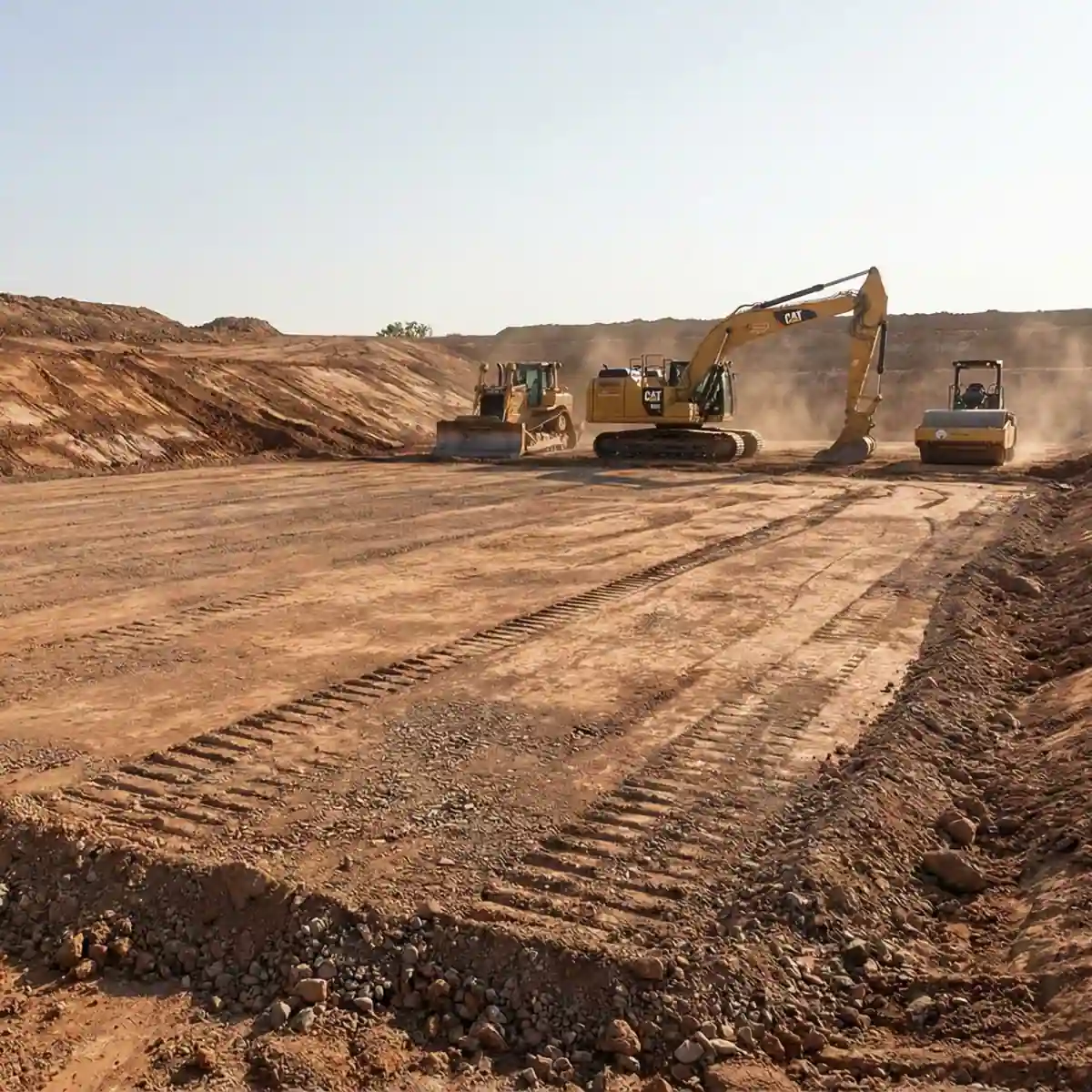
Subgrade, treated subgrade and base are three layers with three specifications
Subgrade
The natural or prepared soil the whole pavement structure rests on. On a TxDOT-referenced job it is built under Item 132, compacted in lifts and tested against its own laboratory curve, with the required density set by the soil's plasticity index1. On Houston Black clay it is the layer most likely to change volume14.
Stabilized subgrade
The same soil after an additive has been mixed into it full depth. Lime alters the clay's particle structure and cuts shrink-swell; cement and fly ash bind particles and add strength2. It is measured by area and depth of treatment, and it has its own curve, density and clock; on a TxDOT job, its own item too: Item 260 for lime, Items 275 and 276 for cement1.
Flexible base
The three are measured, tested and paid as separate items, and a scope that confuses them is not a cheaper scope, it is a different job. Treatment is measured by the square yard at a stated depth and carries mix design, mellowing time and strength testing with it; base is measured by the ton or the cubic yard and carries haul, gradation and depth checks. A subgrade spec that calls for twelve inches of lime treatment under eight inches of base describes two layers, two laboratory curves and two rounds of density tests, and the bid has to describe the same thing.
What the work includes
Which of these a site needs is decided by the geotechnical report and the paving specification rather than by habit: on private work the report and the paving design govern, and on public streets and highways TxDOT's specifications do. Every paving subgrade we build is scarified and compacted; most are then stabilized with lime or cement, and occasionally with cement kiln dust, which still turns up on some Oklahoma work. These are the operations, in the combination the soil and the pavement design call for.
Proof rolling and undercut
A loaded pneumatic roller, at least 25 tons on a TxDOT job and never more than 50, crosses the subgrade at 2 to 6 miles an hour in at least two coverages, each trip offset by no more than a tire width, while a competent person watches for rutting, pumping and deflection1. What yields is undercut to competent material and replaced. It is the only test on the list that finds a soft zone the density gauge missed12.
Moisture conditioning
Discing, watering or aerating the subgrade full depth until it sits inside the moisture window of its laboratory curve, then holding it there through compaction. For a clay with a plasticity index above 35, Item 132 requires the moisture to be at or above optimum when the density is taken1, because a fat clay compacted dry has its swelling still ahead of it.
Lime treatment
One of the additives TxDOT's decision tree offers for a plastic clay subgrade, and the one it lists first from a plasticity index of 15 upward2. Lime reacts with the silica and alumina in clay to alter the particle structure, which is why it is chosen for shrink-swell control rather than for strength alone2. It is spread dry or as slurry, mixed full depth, mellowed for the days the item requires, remixed and compacted1.
Cement and cement slurry treatment
The additive the tree offers first for a subgrade with a plasticity index below 15, and one of the options up to 352. Cement hydrates and binds particles, so it builds strength directly and quickly; TxDOT requires compaction to be complete within two hours of water reaching the mix1. As slurry it goes down without a dust plume and within two hours of being mixed1.
Fly ash and cement kiln dust
Self-cementing Class CS fly ash reacts faster than lime and slower than cement, and TxDOT's guidelines require compaction within six hours of application2. Lime-fly ash blends suit a wider range of soils than lime alone because the cementing action depends less on the clay fines present13. Cement kiln dust is used where a specification names it, and like the rest its rate comes from a mix design against the actual soil.
Flexible base import and compaction
Crushed limestone base hauled from a regional source, spread in the lifts the plans allow, brought to within two percent of its optimum moisture and compacted to 100 percent of its maximum dry density, then depth-checked before it is accepted1. It is the layer the paving crew works off.
How the additive is chosen
We install every additive on this page, which means the recommendation is not shaped by what we happen to own. The selection follows the sequence TxDOT's guidelines lay out: classify the soil, run the sieve and Atterberg tests, measure sulfate, pick an initial additive from the decision tree, then prove it with a mix design2. The soil and the laboratory choose; the specification confirms.
Lime
Effective on plastic clay because it changes the clay itself. Its mechanism is slow, so TxDOT allows a mellowing period of one to four days to reach a friable, homogeneous mixture, with no limit on the time to complete compaction2. The rate comes from a pH series: the lowest lime content that holds the soil-lime mixture at a pH of 12.4, per ASTM D6276 and Part III of Tex-121-E, followed by unconfined compressive strength on specimens cured seven days and then exposed to ten days of capillary rise97.
Cement
Suited to granular and low-plasticity soils, where the FHWA manual notes it is widely used at a plasticity index below about 20 with at least 45 percent passing the No. 40 sieve13. It gains strength fast, which is the constraint as much as the benefit: soil-cement bonds form about two hours after the mix meets water, and further handling breaks them2. The target cement content comes from Tex-120-E, on the strength of specimens cured seven days at 95 percent humidity8.
Cement slurry
The same cement, mixed with water and applied through an agitated distributor rather than spread dry. Item 275 requires the slurry to be applied within two hours of adding water and onto a roadway that is drier than optimum, so the water in the slurry brings the mix to its target1. There is no dust, the rate is metered across the width, and the work goes on beside occupied buildings and live traffic where a dry spread would not be acceptable.
Fly ash
Class CS fly ash is both a pozzolan and a self-setting material, so it cements on contact with water; Class FS is a pozzolan that needs lime or cement as an activator2. Its window is the tightest on the list after cement, six hours from application to finished compaction2, and the day is planned around that window before the spreader arrives.
Cement kiln dust
A by-product of cement manufacture that carries free lime and some cementing capacity. It is an option where the soil responds to it in the laboratory, where a client's specification names it, or where supply favors it. It is not in TxDOT's additive tree2, so on a job that follows the state specification it appears only by special provision, and it is proven the way everything else is: a mix design on the project soil, not a rule of thumb.
Choosing between them
Plasticity index, gradation, soluble sulfate, organic content, the treatment depth, the paving schedule and what the specification permits all narrow the list before anyone picks. TxDOT's guidelines also say plainly that multiple additives can and should be specified on one project when the soil varies enough to warrant it2; a site with a fat clay at one end and a sandy loam at the other is two mix designs, not one.
| Plasticity index | Additives the tree offers | What the mix design then proves |
|---|---|---|
| PI below 15 | Cement; lime-fly ash (Class FS); asphalt where PI is below 6 | Strength gain, since there is little clay for lime to react with |
| PI 15 to below 35 | Lime; lime-cement; lime-fly ash (Class FS); fly ash (Class CS); cement | The lowest additive percentage that meets the project's plasticity and strength targets |
| PI 35 and above | Lime; lime-cement; lime-fly ash (Class FS) | The lime percentage that holds a soil-lime pH of 12.4, then strength after curing |
| Any PI, sulfate above 3,000 ppm | Refer to the sulfate-rich soil guidelines before any calcium-based additive | Whether treatment is safe at all, and at what mellowing time |
One screening step sits ahead of any calcium-based additive in this region. Soluble sulfate in the soil can combine with calcium from lime and alumina from the clay to form ettringite, a mineral more than 200 percent larger in volume than what it grew from13; the result is a pavement that heaves instead of settles. TxDOT measures sulfate by colorimeter under Tex-145-E6, sends anything above 3,000 parts per million to its sulfate-rich soil guidelines2, forbids dry quicklime above that level, and requires at least seven days of mellowing between 3,000 and 7,000 ppm1. Organic content matters too: above one percent, more additive is needed to overcome the organics' exchange capacity2. Both tests are run before a spreader is scheduled.
Flexible base: what the imported layer has to meet
Above the prepared subgrade sits the base course, and on most North Texas paving that is crushed limestone flexible base hauled from a regional pit. Item 247 defines it as a foundation course and gives it a materials table: a master gradation by sieve, plus liquid limit, plasticity index and wet ball mill limits for each grade, with unconfined compressive strength required when the No. 200 fraction is out of specification1.
Base is not a commodity to be swapped freely. The item forbids modifying an aggregate with lime, cement or fly ash to get it to meet the table unless the plans say so1. It is placed in the lifts the plans allow, held within two percent of the optimum moisture from its Tex-113-E curve, rolled from the sides toward the center with each trip overlapping the last by at least half a roller width, and compacted to 100 percent of maximum dry density, with the item's own instruction never to achieve density by drying the material after compaction13. Base placed dry never reaches density, and base that holds water fails from inside whatever its thickness.
Aggregate is also the answer when treatment is not. The FHWA manual notes that some agencies simply remove and replace materials that will not perform, and that where the weak zone is thin or short, removal and replacement is usually the preferred alternative13. Where a soil will not respond in the laboratory, or the schedule cannot absorb mellowing, undercutting and replacing with imported material is often the faster and more certain route to the same platform.

How a finished subgrade is proven
A subgrade is released on evidence, and the paving crew is entitled to a documented platform rather than a surface that looks ready. These are the documents and the tests, and the specification's own numbers for each.
The report and the specification
Two documents govern a paving subgrade: the geotechnical report and the paving specification, which on most North Texas work adopts TxDOT's items by reference. They do not always agree on treatment depth, additive rate or required density. Where they differ we build to the stricter of the two and say so in writing before we mobilize, so the difference is settled at a desk and not at a failed density test.
Proof rolling
Item 216 sets the roller, the load, the speed and the coverage1; the point of it, in the FHWA's words, is to point out soft or yielding material, including zones that met the density requirement but not the moisture, and problems that extend many feet below the surface being tested12. Areas that rut, pump or deflect are marked, undercut and replaced under the layer's own item before anything is built on them.
Density and moisture testing
Each layer has a laboratory curve and a field test against it. The curve for subgrade and embankment soils comes from Tex-114-E4, for base and treated materials from Tex-113-E3, and for lime- and cement-treated mixtures from Tex-121-E and Tex-120-E78. In-place density and moisture are read under Tex-115-E, with the test locations chosen at random by the method in its Part IV5, or with a nuclear gauge under ASTM D6938, which reads density by gamma attenuation to a depth of about 300 millimeters in direct transmission10. A lift passes only when both the density and the moisture sit inside the item's limits.
| Layer and item | Laboratory curve | Field density and moisture | Clock |
|---|---|---|---|
| Subgrade and embankment, Item 132 | Tex-114-E4 | PI 15 or less: at least 98 percent of maximum dry density. PI 15 to 35: 98 to 102 percent, at or above optimum moisture. PI above 35: 95 to 100 percent, at or above optimum1 | Lifts no thicker than 16 inches loose or 12 inches compacted under density control1 |
| Lime treatment, Item 260 | Tex-121-E7 | At least 95 percent of maximum density; moisture no more than 1.0 percent below and 2.0 percent above optimum1 | Mellow 1 to 4 days, 2 to 4 with pebble quicklime, and at least 7 days where sulfate is between 3,000 and 7,000 ppm1 |
| Cement treatment, Item 275 | Tex-120-E8 | At least 95 percent of maximum density, within 2.0 percent of optimum; unconfined compressive strength above 150 psi unless the plans say otherwise1 | Compaction complete within 2 hours of water reaching the cement; density tested within 4 hours1 |
| Flexible base, Item 247 | Tex-113-E3 | At least 100 percent of maximum dry density, within 2.0 percent of optimum, never by drying after compaction1 | Depth checked before acceptance; more than half an inch short is scarified and rebuilt1 |
| Proof rolling, Item 216 | None | A pneumatic roller of at least 25 tons loaded, no more than 50, at 2 to 6 mph, at least two coverages1 | Run before the next layer, and unstable areas corrected under the layer's own item1 |
Plasticity and sulfate testing
The plasticity index says which additive the tree offers and how much the soil is likely to move; it also sets the density and moisture rule the subgrade is held to under Item 1321. Soluble sulfate by Tex-145-E says whether a calcium-based additive is safe at all6. Neither test is slow, and both are cheaper than treating a subgrade twice.
Our paving subgrade sequence
Each step depends on the one before it being right, and the additive chosen in step four decides how many hours step five has to happen in. That is where the schedule time on a subgrade goes.
Read the report and the specification together
Treatment type, depth and rate, required density, base thickness and grade all come out of these two documents. Where they disagree, the stricter one governs and the conflict is put in writing before mobilization.
Strip, shape and proof roll
Topsoil, organics and unsuitable fill come off, the subgrade is brought to rough grade, and it is proof rolled to Item 216 and watched1. Soft areas are undercut and replaced before anything is built over them.
Spread, mix and mellow, or spread, mix and compact
Compact, test and trim to grade
The right roller for the material, then density and moisture against the item's limits, read at the random locations Tex-115-E prescribes5. Failing areas are reworked and retested, and the treated layer is trimmed to line and grade.
Place base and hand over
Flexible base is hauled in, spread in the lifts the plans allow, moistened and compacted to 100 percent of its curve, and depth-checked1. The paving contractor receives the layer with the test results that go with it.
What a correctly prepared subgrade prevents
Pavement distress is legible. Rutting in the wheel paths points at a subgrade or base deforming under load. Alligator cracking points at a section that has lost support from below. A pothole that reappears after every patch points at water reaching a layer that cannot tolerate it. With more than half of a flexible pavement's structural capacity living in its unbound layers11, none of these are surface problems and none of them are fixed at the surface.
TxDOT's guidelines list seven reasons to treat a subgrade, and two of them are about the build itself: to provide a working platform by drying wet areas and temporarily raising strength, and to reduce moisture migration into the section2. A subgrade that stays dry and firm through construction is one the base crew and the paver can work on the day they arrive.
There is a schedule argument as well. A layer that passes on the first round of testing releases the base, and the base releases the paving, on the dates everyone planned around. A layer that fails is reworked, retested and paid for twice in time.
Have paving coming up?
Send the geotechnical report, the paving specification and the area to be paved. We will tell you which additive the soil and the tree point to, what the mix design has to prove, and how many days of mellowing and testing the schedule has to carry.
Paving projects we support
From a retail parking lot to a municipal roadway the questions do not change: what does the soil do, what does the specification require, and what has to be true before the paver arrives.
Parking lots and drive aisles
Commercial, retail and multifamily paving, where the drive aisles carry the loading and the stalls get the scrutiny.
Fire lanes and truck courts
Heavy-duty sections under fire apparatus and loaded trailers, where the design assumes a subgrade that will not deform under a concentrated axle.
Public streets and municipal roadways
City and county paving built and documented to the owner's specification and testing regime, often alongside our construction management scope.
Industrial yards and laydown areas
Large paved and treated yards carrying containers, equipment and constant heavy traffic, where uniformity across the footprint is the whole specification.
Site access and haul roads
Treated running surfaces built early so the rest of the site has somewhere to drive, then rebuilt into permanent pavement.
Reconstruction and rehabilitation
Removing a failed pavement, treating or replacing the subgrade that failed it, and rebuilding the section instead of resurfacing the symptom.
How we approach paving subgrade
Built to both specs
The geotechnical report and the paving specification, read together, with any conflict raised in writing before we mobilize.
Every stabilizer in one scope
Lime, cement, cement slurry, fly ash and cement kiln dust, so the recommendation follows the soil and the mix design.
Slurry when dust is not an option
Metered rates and no plume, beside occupied buildings, traffic and finished work.
Handed over paving-ready
Grade, density, moisture, depth and the test results delivered with the layer.
Paving subgrade across Texas and Oklahoma, from Dallas-Fort Worth
We prepare paving subgrade on commercial, industrial, multifamily and municipal projects across Texas and Oklahoma, to whichever of the report and the paving specification governs. Crews, water trucks, reclaimers and compaction equipment are based in Dallas.
Ask about paving subgrade anywhere we work, across Texas and Oklahoma.
Site address and area to be paved
Geotechnical report and paving specification
Required stabilizer, depth and rate
Base thickness and material grade
Target date for paving
Paving subgrade preparation FAQ
What does paving subgrade preparation include?
Proof rolling and undercutting, moisture conditioning, chemical treatment where the soil calls for it, flexible base import and compaction, and density, moisture and depth testing on each layer against its own laboratory curve. The combination is set by the geotechnical report and the paving specification.
How are subgrade, treated subgrade and base different?
They are three items with three laboratory curves. Untreated subgrade is built and tested under Item 132 against Tex-114-E; a lime- or cement-treated subgrade under Item 260 or 275 against Tex-121-E or Tex-120-E; flexible base under Item 247 against Tex-113-E1. Each carries its own density limit, moisture limit and clock.
Why does the pavement fail when the subgrade is wrong?
Because the design assumed a stiffness for the layer below the surface, and in a flexible pavement the unbound layers often carry more than half of the structural capacity11. A subgrade that deforms or swells takes the support out from under the base, the surface flexes further than it was designed to, and the cracking begins from below.
When is lime used, and when something else?
For a subgrade with a quarter or more of its material passing the No. 200 sieve, the guidelines reach for lime at a plasticity index of 15 and above, and for cement, fly ash blends or asphalt below it2. Between 15 and 35 the tree lists five options, and the mix design picks among them. Above 3,000 ppm of sulfate the calcium-based options are sent to the sulfate guidelines first2.
What is cement slurry treatment and why use it?
Cement mixed with water in an agitated tank and applied through a distributor. Item 275 requires it to go down within two hours of adding the water and onto a subgrade drier than optimum1. It puts no dust in the air and meters the rate evenly, which is what makes it the choice beside occupied buildings and open traffic.
How fast do fly ash and cement have to be compacted?
Cement-treated material must be compacted within two hours of water reaching the mix, and material reworked more than four hours after compaction needs added cement1. Fly ash treatment must be compacted within six hours of application2. Lime has no compaction deadline; it needs a mellowing period of one to four days instead21.
Is cement kiln dust a real stabilizer?
It is used to modify and stabilize marginal soils where the soil responds to it and a specification names it. It is not one of the additives in TxDOT's decision tree2, so on state-referenced work it appears by special provision, and its rate is set by a laboratory mix design on the project soil like every other additive here.
How is the additive rate determined?
By mix design on the actual soil. For lime, the lowest percentage that holds the soil-lime mixture at a pH of 12.4, per ASTM D6276 and Tex-121-E Part III, then unconfined compressive strength after seven days of curing and ten days of capillary rise97. For cement, the content that meets the strength target after seven days at 95 percent humidity under Tex-120-E8. Sulfate and organics are measured before either.
What does flexible base have to meet?
Item 247's Table 1: a master gradation by grade, with liquid limit, plasticity index and wet ball mill limits from each source, and unconfined compressive strength when the No. 200 fraction is out of the table1. In place it is compacted to 100 percent of its Tex-113-E maximum dry density within two percent of optimum, and its depth is checked before acceptance13.
What is proof rolling on a paving job?
A loaded pneumatic roller of at least 25 tons, crossing the subgrade at 2 to 6 miles an hour in at least two coverages, watched for rutting and pumping1. Its purpose is to point out soft or yielding material, including zones that passed density testing12. What yields is undercut and replaced before the next layer.
Sources
Every number and every rule on this page is cited here. Reviewed September 17, 2026.
- Standard Specifications for Construction and Maintenance of Highways, Streets, and Bridges, adopted September 2024Texas Department of Transportation, 2024Item 132 Embankment (density and moisture by plasticity index, lift thickness), Item 216 Proof Rolling (roller weight, speed, coverages), Item 247 Flexible Base (material table, 100 percent density, depth check), Item 260 Lime Treatment (mellowing, sulfate limits, 95 percent density, moisture window), Items 275 and 276 Cement Treatment (two-hour compaction, 150 psi, slurry rules), Item 110 Excavation.
- Guidelines for Modification and Stabilization of Soils and Base for Use in Pavement StructuresTexas Department of Transportation, Construction Division, 2005The five properties a pavement foundation must provide, the seven goals of treatment, the mechanisms and time windows of each additive (fly ash six hours, cement about two hours, lime mellowing one to four days), the additive selection tree by plasticity index and gradation, the 3,000 ppm sulfate and one percent organic thresholds, and the mix design steps.
- Tex-113-E, Moisture-Density Curve for Base, Coarse, and Treated MaterialsTexas Department of Transportation, Materials and Tests Division, 2025The laboratory curve for flexible base and for treated subgrade and base: maximum dry density and optimum moisture content.
- Tex-114-E, Laboratory Compaction Characteristics and Moisture-Density Relationship of Subgrade, Embankment Soils, and Backfill MaterialTexas Department of Transportation, Construction Division, 2011The laboratory curve for untreated subgrade and embankment soils, by soil class.
- Tex-115-E, Measuring In-Place Density and Moisture Content of Soils and Base MaterialsTexas Department of Transportation, Materials and Tests Division, 2025Field density and moisture by nuclear gauge (Part I) and the random selection of test locations (Part IV).
- Tex-145-E, Sulfate Content of Materials Using a ColorimeterTexas Department of Transportation, Materials and Tests Division, 2024The soluble sulfate test, in parts per million, run before any calcium-based additive is chosen.
- Tex-121-E, Lime Treated MaterialsTexas Department of Transportation, Materials and Tests Division, 2022The lime mix design: the minimum lime for a pH of 12.4 (Part III) and unconfined compressive strength after seven days of curing and ten days of capillary rise (Part II).
- Tex-120-E, Cement Treated MaterialsTexas Department of Transportation, Materials and Tests Division, 2022The cement mix design: target cement content from unconfined compressive strength after seven days of curing at 95 percent humidity.
- ASTM D6276-19, Standard Test Method for Using pH to Estimate the Soil-Lime Proportion Requirement for Soil StabilizationASTM International, 2019The pH method for estimating the lime proportion, targeting a soil-lime pH of about 12.4.
- ASTM D6938-23, Standard Test Methods for In-Place Density and Water Content of Soil and Soil-Aggregate by Nuclear Methods (Shallow Depth)ASTM International, 2023The nuclear gauge: density by gamma attenuation, direct transmission to about 300 mm, water content by thermal neutron detection.
- Geotechnical Aspects of Pavements Reference Manual, Chapter 3: Geotechnical Issues in Pavement Design and Performance (FHWA NHI-05-037)Federal Highway Administration, 2006The unbound layers' share of structural capacity (often more than 50 percent of a flexible pavement) and resilient modulus as the governing geotechnical input to pavement design.
- Geotechnical Aspects of Pavements Reference Manual, Chapter 8: Construction and Design Verification for Unbound Pavement Materials (FHWA NHI-05-037)Federal Highway Administration, 2006The purpose of proof rolling and what it detects that a density test does not.
- Geotechnical Aspects of Pavements Reference Manual, Section 7.6: Subgrade Improvement and Strengthening (FHWA NHI-05-037)Federal Highway Administration, 2006The three reasons for stabilization, cement's suitability range, lime-fly ash on a wider range of soils, ettringite growth from sulfates, and removal and replacement of soils that will not perform.
- Official Series Description: Houston BlackUSDA Natural Resources Conservation ServiceClay content of 40 to 60 percent, high shrink-swell potential, cracks 0.5 to 4 inches wide to 12 inches or more deep, and the Blackland Prairie setting.