

Mass Grading Services Across Texas and Oklahoma
Mass grading is the earthwork that turns a site's existing ground into the elevations on the civil plans: the bulk cut and fill, the pads, the swales and basins, and the subgrade under every road and slab that follows. IRONWILL Earthworks grades commercial, industrial, municipal and federal sites across Texas and Oklahoma, from our base in Dallas.
Short mobilization across the metroplex
Cut and fill priced before dirt moves
Water planned, not corrected later
Handed off build-ready, not “close”
Grading decides what every trade after you inherits
Everything a site does with water, and everything a structure sits on, is decided during mass grading. The grade sets where rain goes, how a pad drains, where a detention basin holds, and what density the fill under a slab reaches before concrete ever arrives. A grading mistake is buried under the work of every trade that follows, which is why it is the most expensive earthwork to correct after the fact.
IRONWILL Earthworks self-performs mass grading with our own equipment and field leadership that has graded clay for years. We balance cut and fill before a scraper moves, place fill in tested lifts to the geotechnical report, and hand off a site that the surveyor, the utility crew and the paving crew can start on without a second pass.
Below: what mass grading is and how it differs from fine grading, where the budget actually goes, what clay does to a grade, what has to be in hand before dirt moves, and how we sequence the work. Every rule and every number is cited at the foot of the page.
What is mass grading?
Mass grading is the large-scale cut and fill that brings an entire site from its existing contours to the rough design elevations on the grading plan. It is measured in cubic yards moved and in tenths of a foot of elevation, and it covers the whole footprint at once: pads, parking, roads, drainage and the slopes between them.
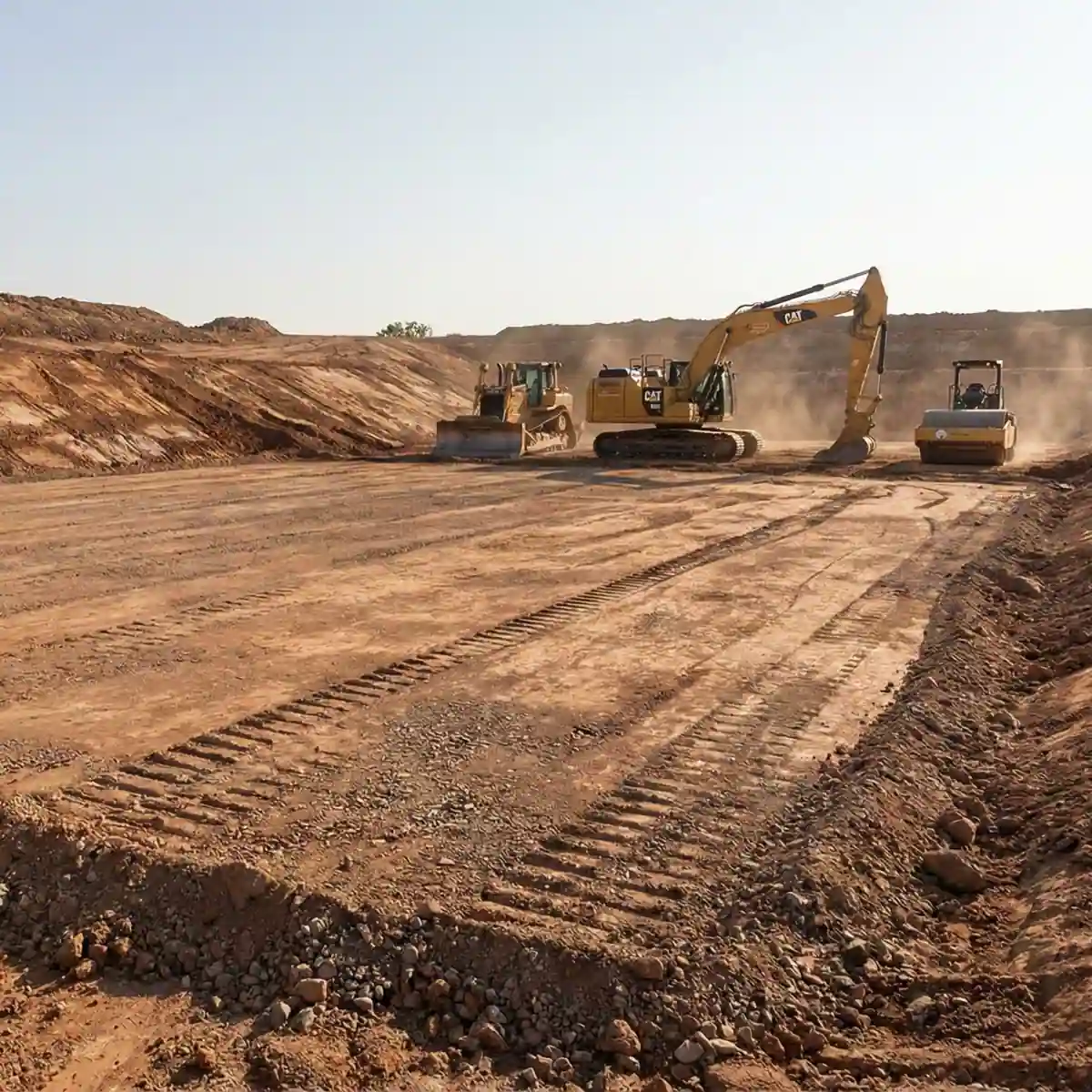
The work is done with scrapers, dozers, excavators, articulated trucks and compactors, built to a three-dimensional model of the design surface. Grade is checked in the field with GPS and laser equipment against that model as the work goes, so a miss is found the day it happens rather than discovered at the end.
Three things have to be true at once for the grade to be finished: the elevations match the plan within the tolerance the specification sets, the fill under anything structural has been placed in lifts and compacted to the density the geotechnical report requires and the project laboratory has verified it78, and water leaves every pad and basin the way the drainage plan intends. A site that has two of the three is not graded.
Mass grading vs. fine grading - what’s the difference?
Mass grading is a volume problem and fine grading is a tolerance problem, and they are bid, scheduled and inspected differently.
Mass grading
Moves the bulk of the earth to bring the whole site to rough design elevation. Priced by the cubic yard and by haul distance. The tolerance is coarse, typically measured in tenths of a foot, because utilities and finish grading still follow.
Fine grading
The finish pass over a much smaller area, just ahead of concrete, pavement or landscaping. Priced by the square yard. The tolerance is tight, often a few hundredths of a foot on a pad or a subgrade, and it is checked by the surveyor immediately before the next trade pours or paves.
Which one you need - IRONWILL
Almost every site needs both, in that order. If the existing ground is more than a few tenths of a foot off the design surface anywhere on the footprint, mass grading comes first; fine grading alone cannot move that much material and is not priced to.
Utilities usually separate the two on the schedule. Mass grading gets the site to rough grade, the wet and dry utility crews cut their lines through it, and fine grading restores the surface to final tolerance once the backfill has been placed and tested. We grade knowing that sequence and leave the surface where the utility contractor needs it, not where a finished pad would be.
What mass grading includes
Cut & fill balancing
Moving material within the site so that the cut volume feeds the fill volume as closely as the design allows, with shrink and swell applied to the raw quantities, so trucks are the exception rather than the plan.
Drainage-conscious grading
Shaping slopes, swales, flow lines and basin bottoms to the civil plan so that runoff leaves the site by the path the drainage study assumed, from the first storm onward.
Building pad rough grading
Bringing pads and structural areas to rough subgrade at the elevation and compaction the geotechnical report specifies, in tested lifts, so the foundation contractor starts on proven ground.
Roadway & access grading
Grading for site roads, fire lanes, drive aisles and internal circulation, so construction traffic has a surface through the build and the pavement section is built on a subgrade at the right elevation.
Subgrade preparation
Haul roads, stockpiles and staging
Planning where material lives while it is being moved: topsoil and select stockpiles, haul routes that keep cycle times and fuel down, and staging that does not sit on ground the next phase needs.
Cut and fill balance is where a grading budget is won or lost
Every cubic yard that leaves a site or arrives on a truck is paid for twice, once to load and once to haul, and a third time if it is disposed of or purchased. A site that balances, where the cut on the high ground becomes the fill on the low ground, pays for the machine time once. Balance is the single largest lever on a grading price, and it is set by the design and the takeoff before any equipment is mobilized.
Balance is rarely perfect. Topsoil has to be stripped and cannot be used as structural fill. Some of what is cut is unsuitable, wet, organic or too plastic, and has to be wasted or treated. Clay that is cut and recompacted changes volume, so the shrink and swell factors from the geotechnical report are applied to the raw cut and fill before anyone knows whether the site has a surplus or a shortfall. Detention and pond excavation counts in the balance too, and often decides it.
Topsoil stripped, stockpiled and reused where it can be
Shrink and swell factors applied to raw cut and fill volumes
Unsuitable material identified before it becomes structural fill
Haul routes planned to keep cycle times and fuel down
Import and export quantities priced up front, not discovered
Pond and utility excavation counted in the site balance


Water is the part of the grade you cannot argue with
Grading is how a site handles rain for the rest of its life. Positive slope away from structures, swales that carry flow to the inlets, and detention that holds what the drainage study says it must hold are all built during mass grading and are all expensive to retrofit. In North Texas more than 60 local governments have adopted the integrated Stormwater Management (iSWM) criteria published by the North Central Texas Council of Governments, and the grading plan we build to is drawn against those criteria2.
Standing water on a graded pad is not a cosmetic problem. It softens the subgrade the concrete crew is about to build on, it puts water into clay that will swell when it takes it up and shrink when it dries4, and it leaves a low spot for the next crew to find with a truck. We walk the drainage before handoff, and if a basin does not drain to its outfall or a pad holds water, it is not finished.
Positive drainage away from every pad and structure
Swales and flow lines shaped to the civil plan
Detention and retention basins cut to design volume
Inlets, outfalls and pond slopes graded to grade
Erosion control installed with the grade, not after it
No trapped low spots left for the next crew to find
Grading on Blackland Prairie clay is not generic earthwork
Much of the metroplex sits on the Blackland Prairie, and its signature soil is Houston Black clay: 40 to 60 percent clay in the control section, classified by the USDA as having high shrink-swell potential, with cracks half an inch to four inches wide opening to a foot or more deep when it dries4. That is why grading here is not generic earthwork. But a soil name is a starting point, not an answer: the same strata can behave differently five miles down the road, so the cut, the fill and the moisture are planned from the project's geotechnical report and its boring logs. The county soil survey is public and we read it first5; the borings are what we build to.
Expansive clay
Expansive clay changes volume with moisture. The plasticity index, measured by the Atterberg limits test6, is the number engineers use to say how much: the higher the PI, the more the soil moves. Fat clay in this region routinely tests above 35, and we have graded sites in Frisco where the geotechnical report showed a PI in the fifties. A grade built on that soil has to control moisture, or the ground will do the moving after the slab is poured.
Moisture conditioning
Clay fill is placed at or wet of its optimum moisture and compacted in lifts, so that it is already close to its swollen state when it is built and has less room to move afterward. The optimum moisture and maximum density for each material come from the laboratory compaction test, standard or modified effort as the specification requires78, and the field density test proves each lift against that curve before the next lift goes on.
Stabilization, where it is called for
Where the geotechnical report calls for it, the subgrade under pavement and pads is stabilized. TxDOT's guidelines select the additive by the soil's plasticity and gradation: for a subgrade with a quarter or more of the material passing the No. 200 sieve, lime is the recommended additive at a PI of 15 and above, cement and fly ash below that, and sulfate content is checked first because sulfate-rich soils react badly with lime10. Lime is one option among several, and the report, not the contractor, chooses it.
Testing governs
Density and moisture testing by the project's independent laboratory is what proves a lift, and we do not cover a lift that has not passed. The test methods are the same ones the state specifications reference, so a pad graded for a private developer is proven the same way as an embankment on a public road9.
To be clear about the roles: we are the earthwork contractor, not the geotechnical engineer or the testing laboratory. The engineer of record sets the fill requirements, the laboratory verifies them, and we build to them. When the ground does not match the report, we say so before we bury it, because a change in the field is cheap and a change under a slab is not.
Plans, permits and stormwater come before the first scraper
In Texas, construction that disturbs one acre or more, or that is part of a larger common plan of development that will disturb one acre or more, is regulated under the TCEQ's Construction General Permit, TXR1500001. Sites of five acres and up are large construction and submit a Notice of Intent; sites of one to under five acres are small construction and post a site notice; both must have a Stormwater Pollution Prevention Plan, which TCEQ abbreviates SWP3, developed and implemented before construction begins1. That plan is written before we mobilize, and the erosion controls in it go in with the grade, not after it.
Geotechnical report
The subsurface investigation says what is down there, what can be reused as fill, what has to be wasted, what moisture and density each material must be placed at, and whether the subgrade needs to be treated. It is the document the whole grade is built to.
Civil plans and earthwork quantities
Grading plans, drainage areas and a cut and fill takeoff turn a design into cubic yards. That takeoff, with shrink and swell applied, is what tells you whether the site balances and what the earthwork will cost before anyone commits to a price.
TCEQ stormwater authorization
Notices of Intent, terminations and changes are filed online through TCEQ's STEERS system1. The SWP3 stays on site through the job and is updated as the work changes.
City permits and floodplain review
Grading and drainage permits vary by city and county across the metroplex. Where any part of a site sits in a mapped floodplain, the federal definition of development includes filling, grading and excavation, so a floodplain development permit from the local floodplain administrator is required before that grading starts3.
Tell us where you are in that sequence and we will tell you what still has to happen before the first scraper moves. Send the plans and the geotechnical report and we will take off the quantities and tell you whether the site balances.
Our mass grading process
Grading is a sequencing exercise as much as a machine exercise. This is the order we work in on every site, whatever its size.
Plans and site review
We read the grading and drainage plans, the geotechnical report, the existing survey and the county soil survey5, and walk the site, so the takeoff is built on the ground that is there rather than the ground the plan assumed.
Earthwork quantities and balance
We take off cut and fill volumes, apply the shrink and swell factors from the report, and tell you whether the site balances, how much is surplus or shortfall, and what that does to the price.
Sequencing, haul routes and stormwater
We set the order of operations, where material is stockpiled, how it travels, and where the erosion and sediment controls from the SWP3 go in before the ground is opened1.
Stripping and rough cut
Topsoil is stripped and stockpiled for reuse, unsuitable material is removed or treated as the report directs, and the bulk cut begins against the design surface.
Rough grade, drainage check and handoff
We shape final rough grade, walk the drainage to confirm nothing traps water, confirm elevations against the model, and hand the site to the utility or fine grading crew with the survey to prove it.
Have a site that needs to be moved?
Send the grading plans, the geotechnical report and the site address. We will take off the quantities, tell you whether the site balances, and come back with a scope and a schedule.
Projects we support
From a single commercial pad to a full subdivision section, the principle does not change: read the ground, balance the dirt, control the water, prove the fill.
Commercial developments
Subdivision development
Industrial and distribution sites
Infrastructure and roadway projects
Large rural and acreage development
Multi-phase construction sites
How we approach grading
Balance-driven grading
Drainage-first approach
Trade coordination mindset
Consistent accuracy
Mass grading across Texas and Oklahoma, from Dallas-Fort Worth
We grade commercial, industrial and municipal sites across Texas and Oklahoma, from single pads to full subdivision sections. Crews and equipment are based in Dallas.
Site address and total disturbed acreage
Grading and drainage plans, if you have them
Geotechnical report and any testing to date
Whether the site is expected to balance
Target start date and access constraints
Mass grading FAQ
What is mass grading?
The bulk cut and fill that brings an entire site from its existing ground to the rough elevations on the grading plan, measured in cubic yards and tenths of a foot. Fine grading is the finish pass that follows.
What is the difference between mass grading and fine grading?
Volume against tolerance. Mass grading moves the bulk of the earth across the whole site to a coarse tolerance and is priced by the cubic yard; fine grading trims a much smaller area to a tight tolerance just before concrete or pavement and is priced by the square yard. Nearly every site needs both.
What does cut and fill balance mean?
A balanced site is one where the material cut from the high ground is enough, after shrink and swell, to build the fill on the low ground, so nothing has to be trucked in or hauled off. Balance is set by the design and the takeoff, and it is the biggest single factor in a grading price.
Do I need a permit for mass grading in Texas?
Usually more than one. Disturbing one acre or more, or being part of a larger plan that will, brings the site under TCEQ's Construction General Permit TXR150000, with a Notice of Intent at five acres and up and a site notice below that, and an SWP3 in place before work starts1. Grading and drainage permits are the city's or county's, and grading inside a mapped floodplain needs a floodplain development permit as well3.
Do I need a geotechnical report before grading?
For anything structural, yes. The geotechnical report identifies which materials can be reused as fill, the moisture and density each must be placed at, and whether the subgrade needs to be stabilized. Without it there is no standard to test the fill against.
How does expansive clay affect grading in Dallas-Fort Worth?
Clay with high shrink-swell potential, like the Blackland Prairie's Houston Black at 40 to 60 percent clay4, swells when wet and shrinks and cracks when dry. How a given site behaves is in its geotechnical report and boring logs, not in the soil's name. Grading on it means placing fill at the moisture the report sets, compacting in tested lifts, keeping water off the finished subgrade, and stabilizing the subgrade where the report calls for it.
How long does mass grading take?
Volume, haul distance, soil moisture and weather drive the schedule more than acreage does. A balanced site in dry weather moves fast; a site that has to import fill, or that takes on water between lifts, does not. We give a schedule with the takeoff, and we tell you what weather does to it.
Who verifies that the fill was compacted correctly?
What happens to the topsoil?
It is stripped before any structural fill is placed, because topsoil is not structural, and stockpiled on site where there is room for it. At the end of the grade it goes back on the areas that will be landscaped or seeded, which is also what the SWP3 usually requires for final stabilization1.
Can grading be coordinated with excavation, utilities and site preparation?
Yes, and it is usually faster and cheaper that way. We self-perform clearing, excavation, grading, subgrade preparation and erosion control, so one crew and one schedule carry the site from raw ground to a surface the utility and paving contractors can start on.
Sources
Every number and every rule on this page is cited here. Reviewed September 17, 2026.
- Stormwater General Permit for Construction Activities (TPDES General Permit TXR150000)Texas Commission on Environmental QualityThe one-acre and five-acre thresholds, the Notice of Intent and site notice, the SWP3 requirement, and filing through STEERS.
- Integrated Stormwater Management (iSWM)North Central Texas Council of GovernmentsThe regional stormwater criteria more than 60 North Texas local governments have adopted, and the iSWM Criteria Manual for Site Development and Construction.
- 44 CFR 59.1, Definitions: "Development"Code of Federal Regulations, U.S. Government Publishing Office, 2023The National Flood Insurance Program definition of development, which names filling, grading and excavation.
- Official Series Description: Houston BlackUSDA Natural Resources Conservation ServiceClay content of 40 to 60 percent, high shrink-swell potential, surface cracks 0.5 to 4 inches wide to 12 inches or more deep, and the Blackland Prairie setting.
- Web Soil SurveyUSDA Natural Resources Conservation ServiceThe public county soil survey for any site in the service area.
- ASTM D4318, Standard Test Methods for Liquid Limit, Plastic Limit, and Plasticity Index of SoilsASTM InternationalThe plasticity index.
- ASTM D698, Standard Test Methods for Laboratory Compaction Characteristics of Soil Using Standard EffortASTM InternationalThe standard Proctor compaction curve fill is tested against.
- ASTM D1557, Standard Test Methods for Laboratory Compaction Characteristics of Soil Using Modified EffortASTM InternationalThe modified Proctor curve, where the specification calls for it.
- 2024 Standard Specifications for Construction and Maintenance of Highways, Streets, and BridgesTexas Department of Transportation, 2024The state specification whose earthwork items (excavation, embankment, lime treatment) and test methods public work in Texas is built and tested to.
- Guidelines for Modification and Stabilization of Soils and Base for Use in Pavement StructuresTexas Department of Transportation, Construction Division, 2005Additive selection by plasticity index and gradation, and the sulfate check (Tex-145-E, 3,000 ppm) before lime is used.