

Erosion Control Services Across Texas and Oklahoma
On a site of an acre or more in Texas, erosion control is a permit condition with a calendar attached: a plan before the first machine, inspections every fourteen days or after every half inch of rain, and stabilization on a clock once the dirt stops moving2. IRONWILL Earthworks installs the controls, keeps them working through the weather, and keeps the site inside that calendar.
Fast response when the weather turns
Soil held in place, not chased downhill
What the SWP3 says, where it says it
Controls that still work in month six
Erosion starts the moment the soil is opened
Erosion begins with the first pass of the dozer, and on clay it begins fast: the Blackland Prairie's Houston Black clay sheds runoff at a high to very high rate because water moves through it very slowly, so a bare clay pad puts most of a storm on the surface and sends it downhill with whatever it can carry11. The controls that matter are the ones that are in the ground before that first storm, not the ones ordered after it.
We install and maintain erosion and sediment controls as part of the same scope as clearing, grading and pad work. The perimeter goes in the day before the ground opens, the inlets are protected the day the storm system is set, and the disturbed area is stabilized the week a phase closes, because the same crew that moved the dirt knows which ground is finished and which is not. We are an earthwork contractor that self-performs the erosion control on its own sites; large standalone erosion control scopes go to specialist partners we have worked with before, and we carry the coordination.
Below: what the work is, why erosion control and sediment control are two different jobs, which controls the regional manual assigns to which problem, what the TCEQ permit requires and by when, and how we sequence it. Every deadline below is the permit's own, and the permit is linked at the end. If a control on your site has already failed, send the address and we will be there before the next storm.
What is erosion control?
Erosion control is the work of keeping disturbed soil where it is and managing the water that crosses it, so that a construction site does not lose material, put sediment into the storm system, or discharge into a creek. In Texas that is not only good practice. Discharging waste, or performing any activity that causes pollution of water in the state, is prohibited except as the state authorizes it8, and the authorization for a construction site is the Construction General Permit1.
The federal rule that started it defines construction activity as clearing, grading and excavation, and draws the line at one acre of disturbance, or less than an acre when the site is part of a larger common plan of development67. Texas runs its own version of that program under the Texas Pollutant Discharge Elimination System: general permit TXR150000, reissued with an effective date of March 5, 2023 and expiring March 5, 20281.
The permit treats erosion control as two things at once. There is the physical work: cover the ground, slow the water, catch what escapes, repair what the last storm broke. And there is the record: a Stormwater Pollution Prevention Plan that says what goes where, inspections on a fixed schedule, and reports signed by an authorized person that show the controls were working the whole time2. A site can fail on either one, and enforcement usually starts with the second.
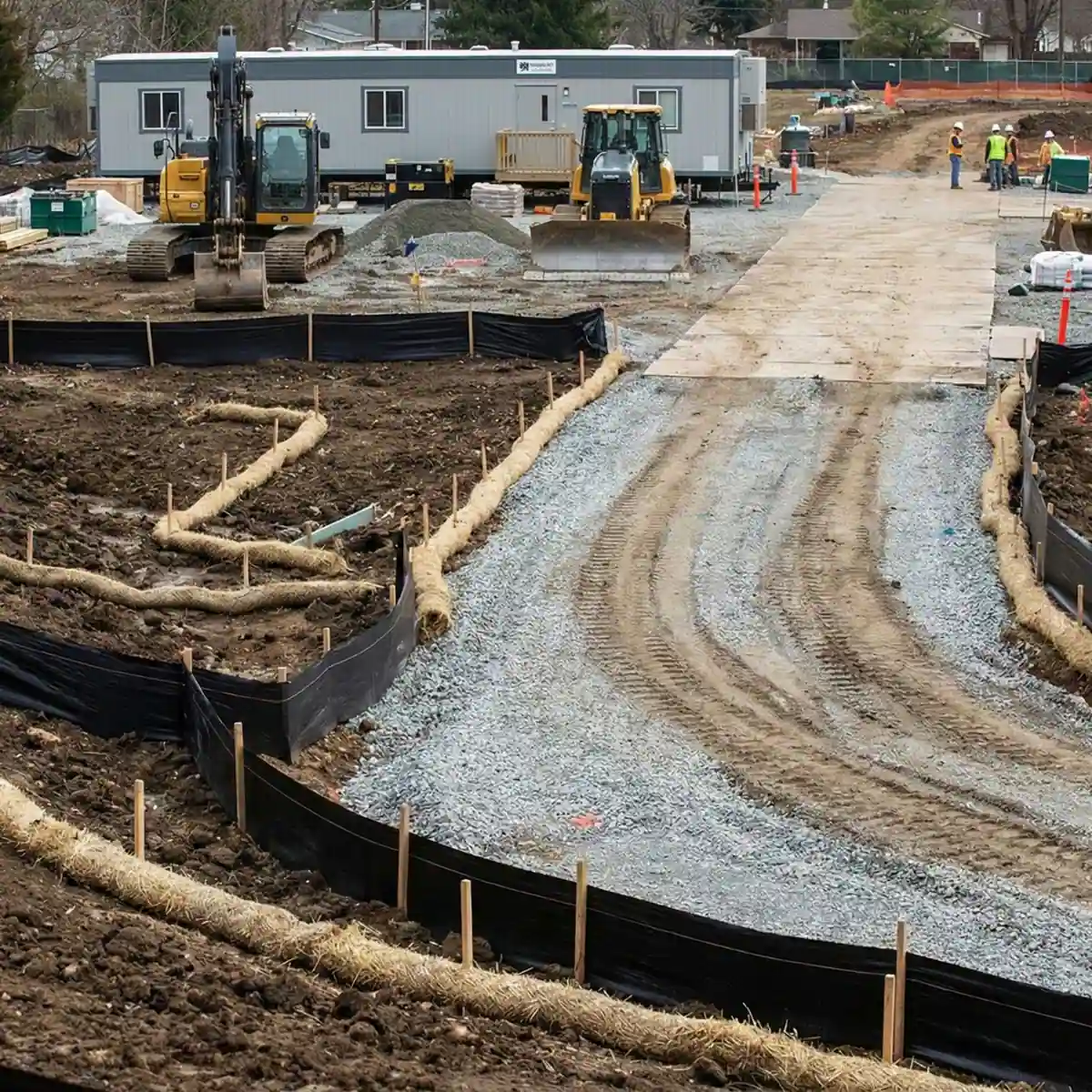
Erosion control vs. sediment control - what’s the difference?
A silt fence is the second line of defense, and the regional manual rates it at half to three quarters effective on a good day. The first line is a covered surface.
Erosion control
Keeps soil from detaching in the first place: mulch, blankets and matting, temporary and permanent seeding, diversions that keep clean water off bare ground, and slope lengths broken up before runoff can gain speed. EPA's own guide puts it plainly: erosion control measures protect the soil surface and prevent particles from being dislodged, and it is usually easier to prevent erosion than to control sedimentation5.
Sediment control
Catches soil that is already moving: silt fence, filter tubes, inlet protection, rock check dams, traps and basins. Every one of them is a settling or filtering device, and every one of them is rated by the regional manual at less than 100 percent, most of them at 0.50 to 0.754. Sediment control is what stops the failure of erosion control from leaving the site.
Which one a clay site needs
Both, in that order, and here the order matters more than most places. The regional manual states that silt fence is most effective on coarse to silty soils, has limited effectiveness with clay soils because the fabric clogs, and should be used with caution where clay predominates4. Houston Black is 40 to 60 percent clay11. A perimeter fence on this ground ponds water more than it filters it.
The same manual rates a sediment basin at 0.90 on sand and 0.50 on clay, because clay particles settle slowly, and notes that where fine silt and clay predominate the basin may need a passive or active treatment system to take the fines out4. The practical conclusion is the one we build to: on clay, spend the effort on cover and on slowing the water down, and treat every downstream device as a backstop rather than a plan.
What our erosion control includes
Perimeter controls and silt fence
Stabilized construction entrances
A pad of three to five inch stone at least six inches thick on geotextile at every point where a truck leaves the site, sloped away from the pavement and re-dressed when the voids fill4. The manual calls for one on every site of an acre or more, and it is the control a city inspector sees from the street.
Inlet and storm drain protection
Protection on every inlet that can receive site runoff, on the site and on the street below it, built to filter without blocking the drain when a real storm arrives. The manual rates inlet protection lowest of the sediment controls, at 0.35 to 0.65, and positions it as a second line behind the perimeter and the cover, which is where we place it4.
Slope and channel stabilization
Erosion control blankets, turf reinforcement matting, rock check dams nine to thirty-six inches high in swales, and riprap at pipe outfalls, wherever water concentrates and picks up speed4. These are the places a silt fence cannot help, and the manual says so in as many words.
Temporary and permanent seeding
Hydromulch, temporary seeding and permanent vegetation, with seed bought and applied on a pure live seed basis and the rate raised a quarter when it is broadcast rather than drilled, as the state specification requires9. Cover is the control that stops erosion; everything else manages the consequences.
Maintenance, repair and inspection support
Controls repaired after storms, sediment removed before a fence reaches half its height or a check dam a third of its4, and measures resized when the site produces more runoff than the plan assumed. On public work the specification gives a contractor seven calendar days, or the next anticipated rain, whichever comes first, and stops the job if the correction is not made9.
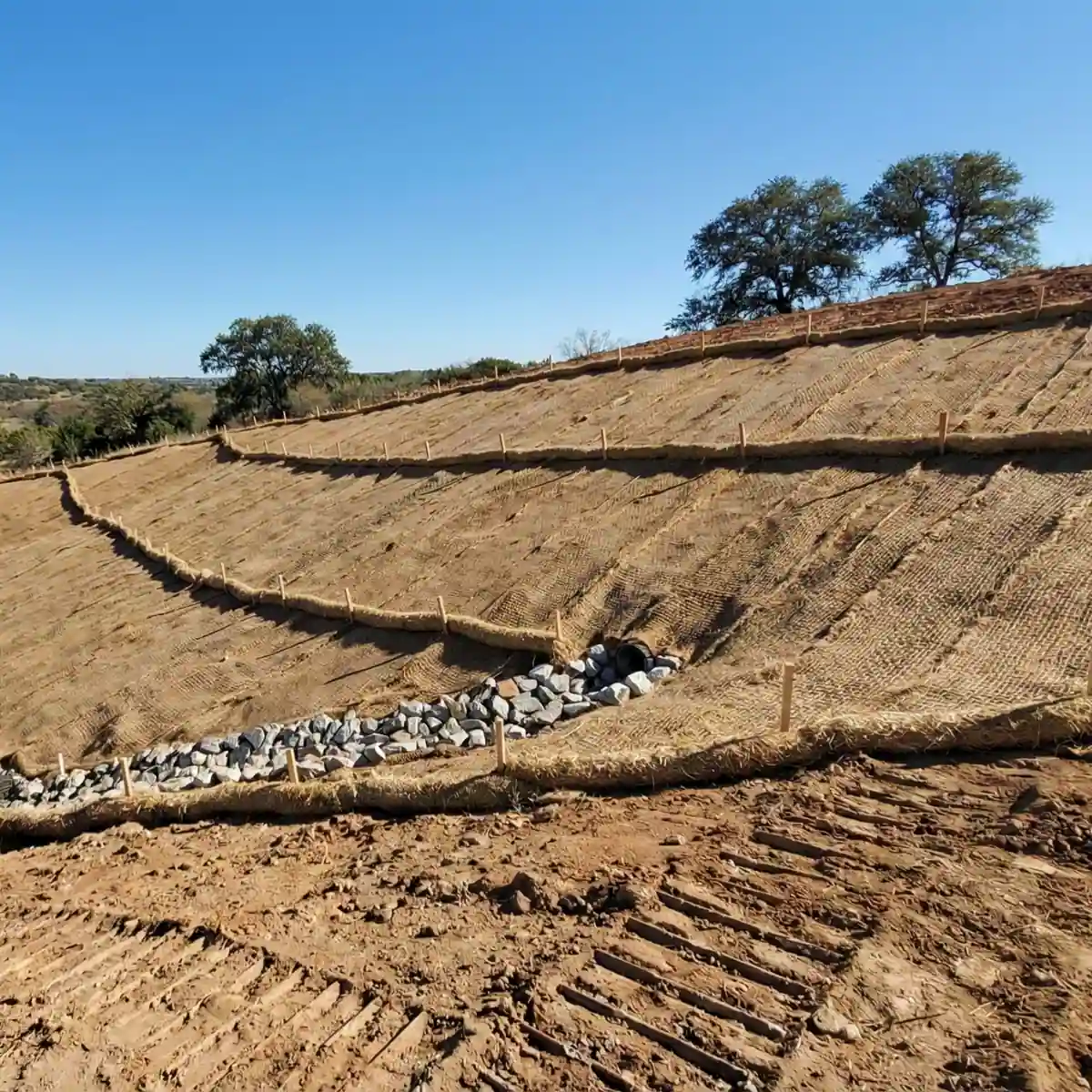
Where water concentrates is where controls fail
Sheet flow across a flat pad is the easy case. The regional manual limits silt fence to a quarter acre of drainage per hundred feet of fence and to two hundred feet of flow distance, fifty where the slope exceeds ten percent, because beyond those limits the water arrives concentrated and the fence either overtops, blows out or cuts around its own ends4. Velocity is what moves soil, and velocity comes from slope and from how far water has run without interruption.
That is also where the wrong control gets installed. The manual is explicit that silt fence is not for use as a check dam in swales or low areas subject to concentrated flow, and that where two runs meet at an angle or cross a minor channel the fence has to be backed by a rock berm or sandbags4. Concentrated flow needs a check dam, matting, riprap or a trap, and it needs it before the first storm finds the low spot.
Slope length broken with diversions and berms before runoff gains speed
Blankets and matting on cut and fill slopes where seed alone will not hold
Rock check dams in swales, the downstream crest level with the upstream toe
Riprap and energy dissipation at every pipe outfall
Diversion dikes keeping clean water off disturbed ground
Sediment traps and basins sized to the drainage area, not to the fence line
What the TCEQ permit requires, and by when
Any site disturbing one acre or more, or part of a larger common plan of development that will, is regulated under TXR150000. Five acres and up is a large construction activity and files a Notice of Intent; one to five acres is small and is authorized by posting the site notice12. The permit defines commencement of construction as the initial disturbance of soils by clearing, grading or excavation, and also by demolition, grubbing and stockpiling of fill2, so the clock starts before most people think it does.
The permit is a calendar as much as a specification. These are its deadlines, in the order a project meets them.
| Event | What the permit requires | Deadline |
|---|---|---|
| Before the first disturbance | SWP3 developed and implemented; site notice posted where the public can read it | Before construction commences |
| Large site, 5 acres or more | Notice of Intent filed through STEERS by each primary operator | Electronic: authorized on confirmation of receipt. Paper waiver: at least 7 days before work |
| Two days before work | Copy of the NOI to the MS4 operator and any secondary operator | 2 days prior to commencing |
| Routine inspection | Walk every control and every discharge point; written report | Every 14 calendar days and within 24 hours of a 0.5 inch storm, or every 7 calendar days by election |
| A control has failed or the plan is not working | Revise the SWP3 and fix the control | SWP3 revised within 7 calendar days; changes in place before the next storm where possible |
| Work stops on any part of the site | Initiate stabilization of that area | By the end of the next work day, whenever activity will pause more than 14 calendar days |
| Stabilization initiated | Complete the temporary cover | Within 14 calendar days of initiation |
| Site finished | Final stabilization, then Notice of Termination | NOT within 30 days of final stabilization |
| After termination | Keep the SWP3, reports and site notice | 3 years from the NOT |
Plan and notice first
The Stormwater Pollution Prevention Plan, which TCEQ writes as SWP3, must be developed and implemented before construction begins1. TCEQ publishes a template for it10. Large sites file the NOI electronically through STEERS and are authorized on confirmation of receipt; an operator with a paper waiver files at least seven days ahead and is provisionally covered 48 hours from the postmark2. The site notice goes up before work starts and stays up until final stabilization2.
Inspections on the permit's schedule
At least once every fourteen calendar days and within 24 hours of the end of a storm of half an inch or more, or once every seven calendar days if the plan elects that schedule, in which case the inspection happens whether or not it rained2. Areas that have reached final or temporary stabilization drop to monthly2. Each report is retained in the SWP3 and signed the way the state's signatory rule requires2.
Repair and revision on a seven day clock
When an inspection finds a control that is not working, the SWP3 must be revised within seven calendar days and the change put in the ground before the next storm event wherever that is practicable2. Most enforcement follows a maintenance failure, a buried inlet, a full trap, a fence lying flat, rather than a site that installed nothing. The seven days are the difference between a repair and a violation.
Stabilization, then termination
Wherever work stops for more than fourteen calendar days, or stops for good, stabilization must be initiated by the end of the next work day and completed within fourteen days of initiation2. Final stabilization is a uniform perennial cover at a density of at least 70 percent of the native background, or an equivalent permanent measure such as riprap or gabions2. Only then can the operator file a Notice of Termination, due within 30 days, and the records are kept three years beyond it2.
Our role in that is precise. The permit makes the operator responsible: the party with control over the plans and the party with day-to-day control of the site are both operators, and the property owner who hires a general contractor is usually the secondary one2. We build and maintain to the SWP3 your engineer prepared; we do not prepare it and we do not sign your inspection reports. What we will do is tell you when the field no longer matches the plan, usually before an inspector does.
Our erosion control process
Erosion control is not an install-once scope. It runs beside the earthwork and changes shape as the site does, and the permit expects the plan to change with it2. This is the order we work in.
Site and plan review
We read the SWP3 against the actual ground: slopes, flow paths, discharge points, the drainage area behind each perimeter run, and where the disturbance will be phased. A fence drawn across a swale on the plan is caught here, not in the first storm.
Install before the ground opens
Perimeter controls, the stabilized exit and inlet protection go in before clearing or grading starts, which is what the permit means by implementing the plan before construction commences2. A basin or trap for any common drainage point that will serve ten or more disturbed acres is built first, sized to the two-year, 24-hour storm from each acre or to 3,600 cubic feet per acre drained2.
Phase controls with the work
As areas open and close the controls move with them: diversions around active pads, protection on each new inlet, and temporary cover on any ground that will sit idle, on the permit's fourteen-day clock2.
Storm response and repair
After a half-inch storm the controls are walked inside the 24 hours the permit allows the inspection2: undercut fence re-keyed, check dams reset, exits re-dressed, inlet protection cleared, and any breach closed before the next event.
Permanent stabilization and removal
Permanent vegetation or hard stabilization is established to the 70 percent standard2, temporary controls come out once the ground behind them holds on its own, and the operator files the NOT with the records to support it.
What erosion control is actually protecting
The visible loss is the soil that leaves. The expensive losses are downstream of it: a subgrade softened past the point of compaction, a detention pond filling with the pad it was built to protect, a neighbor's parking lot under your silt, an inlet plugged on a public street, and a stop-work order while it is all cleaned up. Every one of those is cheaper to prevent with a covered surface and a maintained perimeter than to remedy after a storm.
Weather is the one variable nobody controls. EPA's guide lists ten keys to effective erosion and sediment control, and the first five are about erosion rather than sediment: minimize the disturbed area, phase the work, control the water flowing onto and through the site, stabilize soils promptly, protect slopes5. A site run that way treats a rain event as a day lost rather than a week.
Soil kept on the site instead of in the storm system
Subgrades kept from saturation and rework
Neighboring property and receiving waters protected
Inspections and revisions inside the permit's own deadlines
Fewer weather delays and less rework after each storm
Detention and drainage kept clear of construction sediment
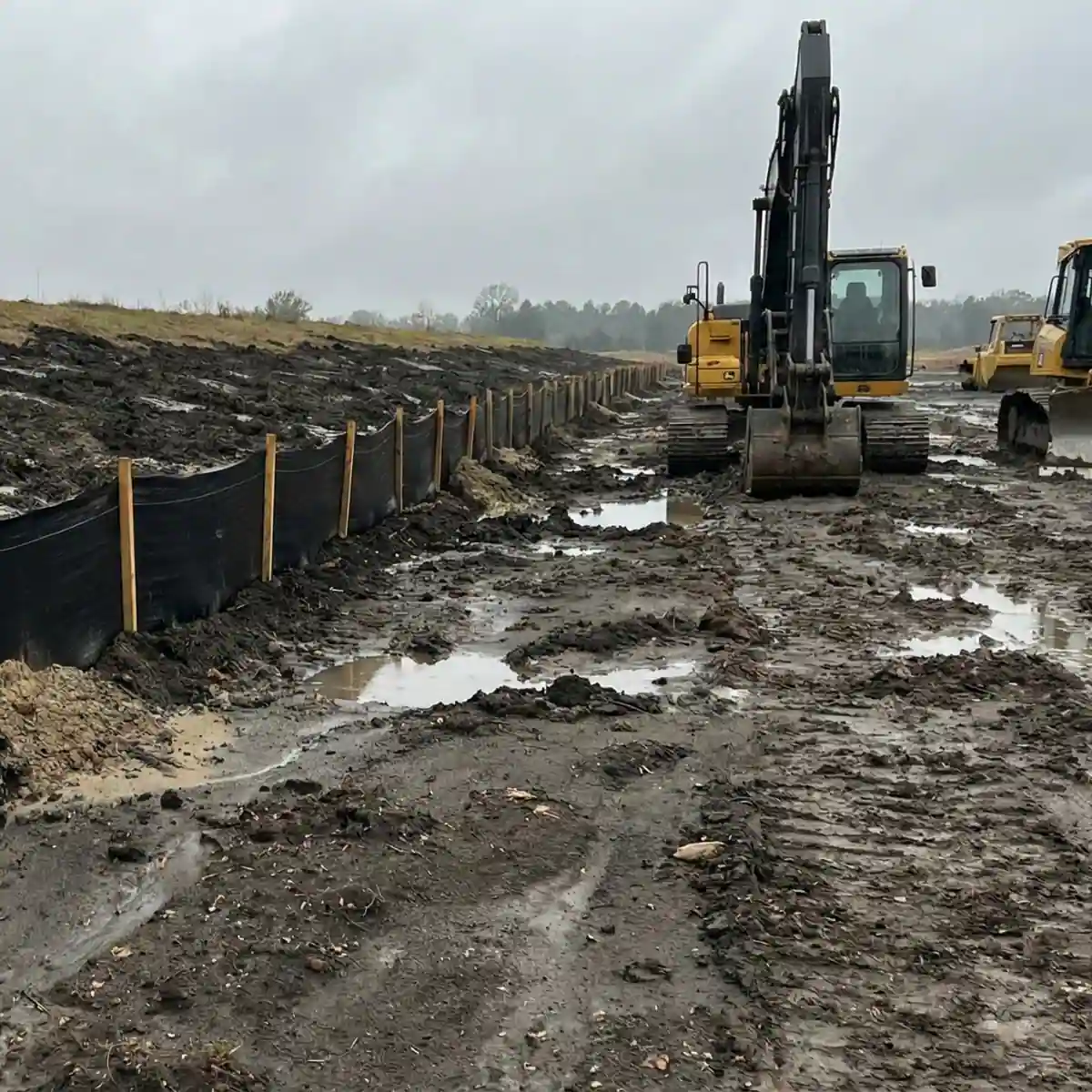
Need controls installed - or fixed?
Send the site address, the disturbed acreage and the SWP3 if one exists. We will tell you what has to be in the ground before it opens, what the permit's calendar looks like for your phasing, and how fast we can be there if something has already failed.
Projects we support
From a single pad to a phased development, the principle does not change: cover the ground, slow the water, catch what escapes, and keep it all working until the site can hold itself together.
Commercial development sites
Retail, office, medical and mixed-use sites where the perimeter, the exit and the inlets have to hold from clearing through final stabilization while the trades work around them.
Industrial and distribution sites
Large footprints where a single drainage point can serve more than ten disturbed acres and the permit calls for a basin, sized and built before the mass grading starts2.
Sloped and uneven properties
Sites where grade does the damage: blankets, check dams and diversions placed where velocity actually builds rather than where a plan sheet put them.
Drainage and detention improvements
Channels, swales, basins and outfalls stabilized so the improvement does not become the next erosion problem, with riprap and dissipation at every discharge.
Rural and acreage development
Yards, pads and access roads on larger tracts, where runoff has a long way to travel before anything slows it down and diversions do most of the work.
Sites already out of compliance
A failed inspection, a blown perimeter or a notice from the city. We mobilize inside the permit's seven-day repair window2, fix what is there, and bring the site back into shape.
How we approach erosion control
Practical, not over-engineered
Controls sized to the drainage area behind them and to the manual's limits, not to inflate a scope4.
Construction-aware placement
Controls that work with equipment flow instead of getting run over in week two.
Maintained through the job
Storm response and sediment removal on the permit's clock, not an install and a handshake.
Integrated with the earthwork
Sequenced alongside clearing, grading and pad work under one contractor, so the controls move when the dirt does.
Erosion control across Texas and Oklahoma, from Dallas-Fort Worth
We install and maintain erosion and sediment controls on our own commercial, industrial, multifamily and municipal sites across Texas and Oklahoma. Crews and equipment are based in Dallas, which matters most when something fails and it is still raining. In North Texas the controls are usually built to the iSWM criteria, which more than 60 local governments have adopted3.
Inspection and repair need a crew that can reach the site the same day, so ask wherever the job is in the region.
Site address and disturbed acreage
SWP3 or erosion control plan, if one exists
Current stage: before clearing, active, or stabilizing
Whether anything has already failed or been cited
Target schedule and site access
Erosion control FAQ
What is erosion control?
Keeping disturbed soil in place and managing the water that crosses it, so that sediment stays off the street, out of the storm system and out of the creek. On a regulated site it is a permit condition1.
What is the difference between erosion control and sediment control?
Erosion control prevents soil from detaching: cover, seeding, blankets, diversions. Sediment control catches soil already on the move: fence, inlet protection, traps, basins. EPA's guide treats the first as the primary means and the second as the backup5.
Do I need erosion control on my construction site in Texas?
Yes if the site disturbs one acre or more, or is part of a larger common plan that will. Coverage is under TCEQ general permit TXR150000, which requires an SWP3 in place before construction begins1. Many cities require controls on smaller sites under their own ordinances.
What is a SWP3 and do I need one?
How often do erosion controls have to be inspected?
Why does silt fence fail?
Usually one of three reasons: it was laid on the surface instead of keyed into the ground, so water undercut it; it was put across concentrated flow instead of sheet flow, so it overtopped or cut around the ends; or nobody removed the sediment before it reached half the fence's height4. On clay there is a fourth: the fabric clogs and ponds rather than filters4.
What is a stabilized construction entrance and do I need one?
When can erosion controls be removed?
Temporary controls come out once the ground behind them holds on its own. Under the permit, a Notice of Termination requires final stabilization first: uniform perennial cover at 70 percent of native background density, or equivalent permanent measures such as riprap2. Coverage terminates on TCEQ's receipt of the electronic NOT2.
Does clay change how erosion control works?
It changes what works. The regional manual rates silt fence as limited on clay because it clogs, and rates a sediment basin at 0.50 on clay against 0.90 on sand4. Houston Black clay sheds runoff at a high to very high rate11. Cover and velocity control carry the load here; downstream capture is the backstop.
Can erosion control be handled together with clearing and grading?
Yes, and it is the better way. The permit's clock runs from the first disturbance2, so the crew that opens the ground is the crew best placed to have the perimeter in the day before, and to move the controls as the grading changes the site rather than leaving them where they were first installed.
Sources
Every number and every rule on this page is cited here. Reviewed September 17, 2026.
- Construction General Permit TXR150000Texas Commission on Environmental Quality, 2023The effective date of March 5, 2023 and expiration of March 5, 2028, the one-acre and five-acre thresholds, the SWP3 requirement, STEERS filing, and the site notice forms.
- TPDES General Permit TXR150000, Stormwater Discharges from Construction ActivitiesTexas Commission on Environmental Quality, 2023The permit text: definitions of operator, commencement of construction and final stabilization (Part I); NOI timing and site notices (Part II.E); the Notice of Termination and three-year records (Part II.F); SWP3 revision within seven days, stabilization deadlines, the ten-acre basin rule and inspection frequencies (Part III).
- iSWM Program for Construction and DevelopmentNorth Central Texas Council of GovernmentsThe regional stormwater criteria more than 60 North Texas local governments cooperate on.
- iSWM Technical Manual: Construction ControlsNorth Central Texas Council of Governments, 2019Efficiency ratings for each sediment control, silt fence design limits and clay-soil caution, sediment basin effectiveness by soil type, check dam and stabilized construction exit criteria, and maintenance thresholds.
- Developing Your Stormwater Pollution Prevention Plan: A Guide for Construction SitesU.S. Environmental Protection AgencyErosion control against sediment control, and the ten keys to effective erosion and sediment control.
- Stormwater Discharges from Construction ActivitiesU.S. Environmental Protection Agency, NPDESThe one-acre federal threshold, the larger common plan rule, and the 2022 federal Construction General Permit.
- 40 CFR 122.26, Storm water dischargesCode of Federal Regulations, U.S. Government Publishing Office, 2023The federal definition of construction activity as clearing, grading and excavation.
- Texas Water Code, Chapter 26, Section 26.121: Unauthorized Discharges ProhibitedTexas Legislature OnlineThe prohibition on discharging waste or performing any activity that causes pollution of water in the state, except as the commission authorizes.
- 2024 Standard Specifications for Construction and Maintenance of Highways, Streets, and BridgesTexas Department of Transportation, 2024Item 506, Temporary Erosion, Sedimentation, and Environmental Controls: the seven-day correction window, the Approved Products List, fence, rock filter dam and construction exit materials; Item 164, Seeding for Erosion Control: pure live seed and the 25 percent rate increase for non-drill methods.
- Stormwater Pollution Prevention Plan Template for Construction (RG-639)Texas Commission on Environmental QualityThe SWP3 template TCEQ publishes for construction sites.
- Official Series Description: Houston BlackUSDA Natural Resources Conservation ServiceClay content of 40 to 60 percent, very slow permeability, and runoff rated high to very high.