Land Clearing · North Texas

Land Clearing Services in Dallas-Fort Worth & North Texas

Removing what has to go and protecting what stays. IRONWILL Earthworks clears trees, brush and stumps to the line the project actually needs — then hands the site over stabilized and staged for grading rather than covered in piles.
Forestry mulching
Grubbing & stripping
Tree protection
Stump grinding
Debris haul-off
Dallas-based

Short mobilization across the metroplex

Cleared to a plan

What stays is decided before we start

Build-ready, not just bare

Grubbed and stripped where it matters

Clearing through site prep

One contractor all the way to build-ready

Where a site begins

Clearing is easy. Clearing the right things is the job.

Land clearing is the first earthwork activity on almost every site, and everything behind it — grading, utilities, concrete — is waiting on it. It is also the phase where the most permanent mistakes get made, because a tree taken out or a root zone driven over cannot be put back.
IRONWILL Earthworks is a North Texas earthwork contractor. We clear to a marked line, protect what you are keeping, choose the right method for what each part of the site has to carry, and hand the property straight into grading and site preparation.
Below: what land clearing is, how mulching differs from grubbing, how trees are actually protected, what the city will want, and how the work sequences. If you have a property to clear, send us the details.
Definition

What is land clearing?

Land clearing is the removal of trees, brush, stumps and vegetation from a property so it can be built on, accessed, farmed or maintained. On a construction site it is the first earthwork phase — the one that opens access, exposes the ground and sets the conditions every trade after it works in.
There is a wide range inside that definition. Clearing can mean grinding brush into mulch and leaving it where it falls, or it can mean digging out every stump and root ball and hauling them off. Those are different jobs with different prices, and the right one depends entirely on what the ground is going to be asked to do afterwards.
It is also the phase with the least margin for error. Grading mistakes get regraded and drainage gets recut, but a tree that comes out does not go back — and in most metroplex cities, one that comes out without a permit becomes a mitigation bill.
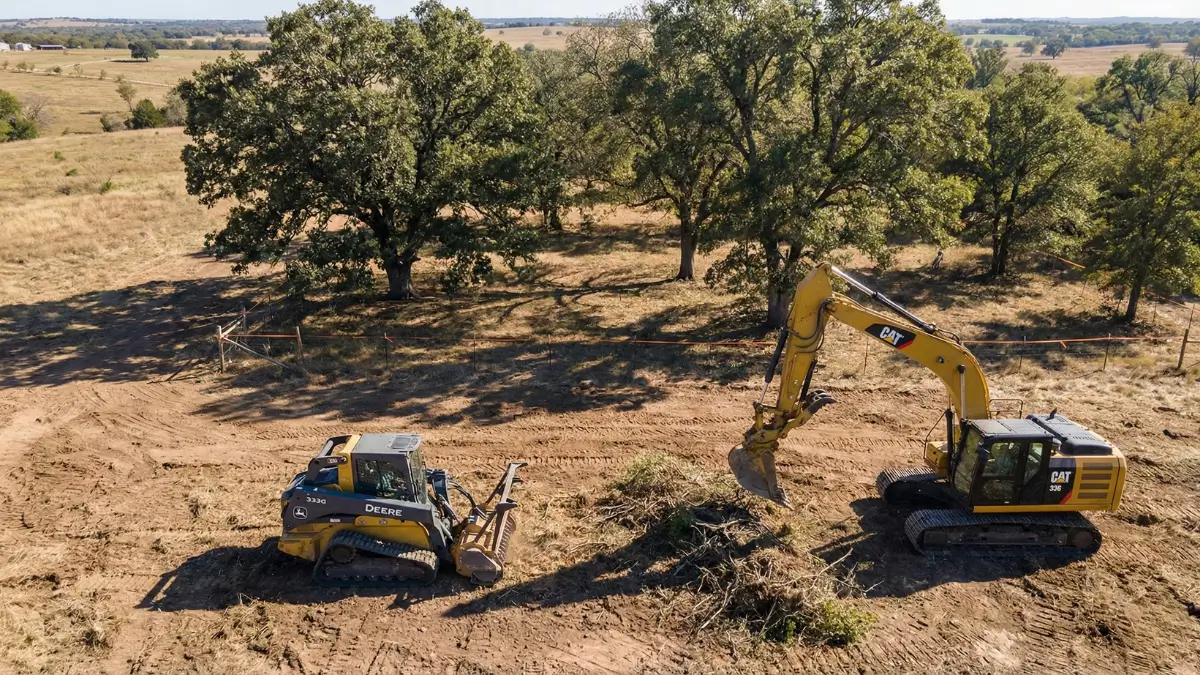
Selective land clearing in Texas removing brush and small trees while preserving larger trees for construction site preparation.
Often confused

Forestry mulching vs. grubbing — what’s the difference?

Mulch is a finish for land you are keeping. It is not a base for anything you intend to build on.

Forestry mulching

A mulching head grinds standing brush and small trees into a mulch layer left on the ground. Fast, low ground disturbance, nothing to haul, and the mulch itself holds soil in place. Roots and the organic mat stay where they are.

Grubbing & stripping

Stumps, root balls and the organic mat are dug out and removed, and topsoil is stripped. Slower, and it generates material to haul — but it is the only version that leaves ground you can build structure on.

Which one you need — IRONWILL

It comes down to what the ground has to carry. Pasture, fire breaks, access corridors and anything staying green can be mulched. Building pads, pavement and structural fill have to be grubbed and stripped, because organic material left underneath decomposes and the ground settles.
Most properties are a mix of the two, and pricing them as a mix is what keeps the cost down. We mulch the areas that will stay vegetated and grub only the footprint that has to carry load — cheaper than grubbing everything, and it avoids the settlement problem entirely.
Scope

What our land clearing includes

Selective clearing

Targeted removal of brush, undergrowth and unwanted trees while priority vegetation, buffers and sightlines stay. The line between keep and remove is walked and marked before a machine starts, not decided from the seat.

Complete clearing and grubbing

Full removal of trees, brush, stumps and root systems to open a site for pads, roads, utilities and grading — down to ground that will carry structure.

Forestry mulching

Standing brush and small-diameter trees ground in place into a mulch layer. No burning, nothing to haul, and the mulch holds the surface until the next phase begins.

Tree protection

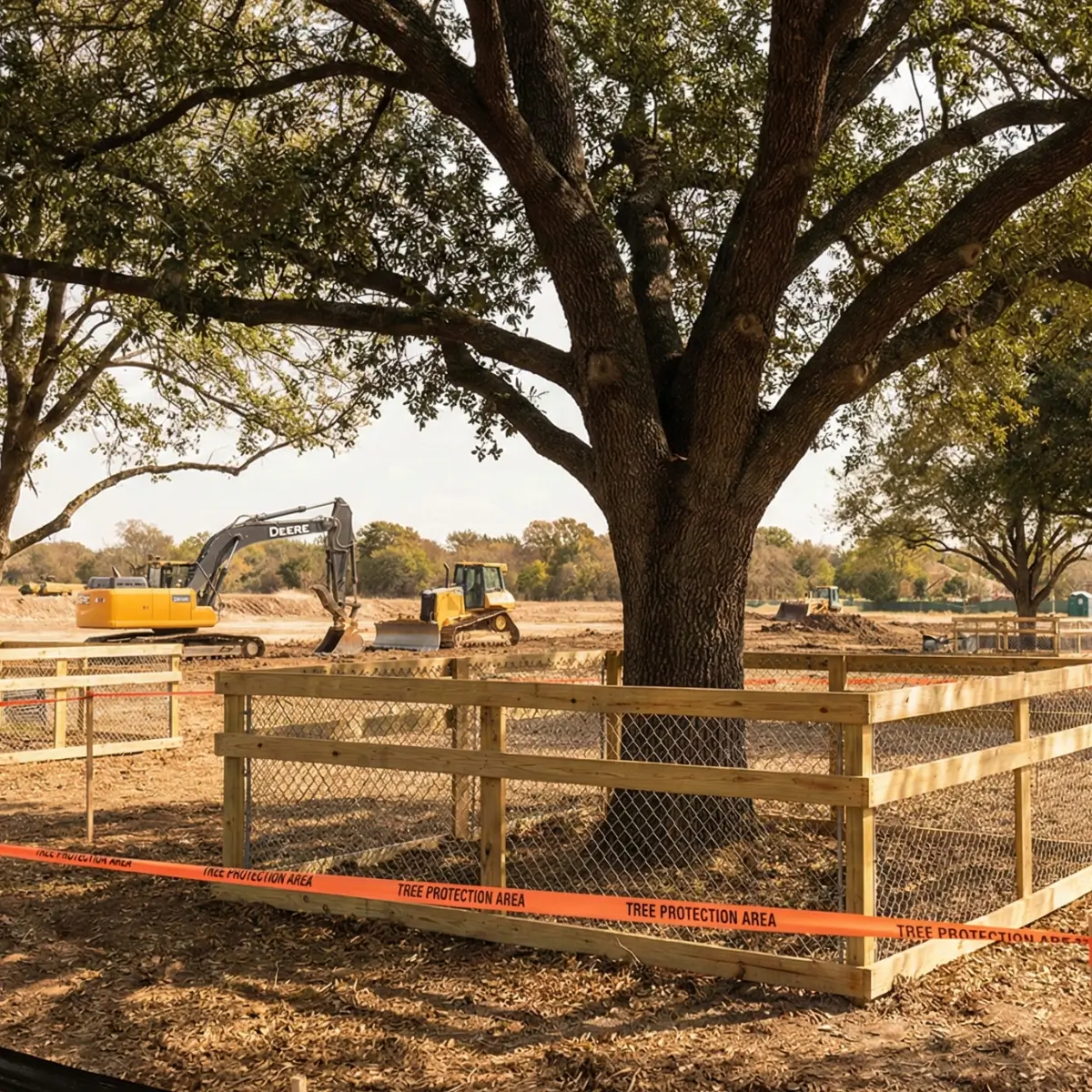
Protection zones fenced, critical root areas kept clear of traffic and storage, and equipment routed around the trees that are staying — before clearing begins, not after a root has been cut.

Tree trimming and limb removal

Limbing for equipment clearance, hazard removal and safe access along drives, fence lines and work corridors.

Stump grinding and debris removal

Stumps and surface roots ground out, debris chipped, consolidated or hauled off, and the site staged for grading rather than dotted with piles.
What stays

The trees you keep are protected before clearing starts

Most tree loss on a construction site does not come from a saw. It comes from equipment traffic, material storage and grade changes inside the root zone — compaction and root damage that kill a tree slowly enough that nobody connects it back to the clearing crew.
Protection is cheap, physical and entirely front-loaded: fence the zone, keep traffic and stockpiles out of it, and route the work around it. Done at the start it costs a roll of fence. Done after the fact it costs a replacement tree and, in most metroplex cities, mitigation on top.

Keep trees identified and marked before mobilization

Protection fencing set at the critical root zone, not the trunk

No traffic, storage or stockpiling inside the fence

Grade changes around retained trees flagged early

Root pruning done cleanly where it cannot be avoided

Protection maintained through grading, not pulled on day two

Before the saws start

Tree ordinances and stormwater rules come first

Across Dallas-Fort Worth, removing trees on commercial property is regulated, and clearing an acre or more triggers stormwater requirements. Both are far cheaper to handle before a machine arrives than after a neighbour calls the city.

City tree ordinances

In Dallas, removing protected trees on commercial property requires a tree removal permit or a building permit and is subject to mitigation, while single-family and duplex lots under two acres are exempt. Every other city in the metroplex has its own ordinance, its own protected sizes and its own mitigation formula.

Stormwater authorization

Clearing is land disturbance. A site disturbing one acre or more — or that is part of a larger common plan of development that does — falls under TCEQ’s Construction General Permit and needs a stormwater plan and perimeter controls in place before the ground is opened.

Nesting season

Active nests of migratory birds are federally protected. Heavy clearing in spring is worth checking rather than assuming, because an active nest found mid-job stops work in that area until it is finished.

Debris and burning

Open burning is restricted across most of the metroplex and prohibited outright in many cities, and county burn bans come and go with the weather. Plan on chipping, mulching in place or hauling off rather than on a burn pile.
To be clear about our role: we do not issue the permits and we are not your arborist. What we will do is tell you which of these apply to your property before we quote it, so the schedule is built around them instead of interrupted by them. If the site has not been looked at yet, that is where site analysis starts.
How it works

Our land clearing process

Clearing goes wrong in the planning, not in the cutting. This is the order we work in so the right things come out, the right things stay, and the site is handed over ready for what follows.
01

Site walk and scope

We walk the property with you: the build footprint, access routes, what has to come out and what you want kept. Ambiguity at this stage is what produces the tree nobody meant to lose.
02

Permits, protection and stormwater

Tree ordinance requirements confirmed, protection zones fenced, and perimeter erosion controls and a stabilized entrance installed before any clearing starts.
03

Method by area

We decide which areas get mulched and which get grubbed and stripped, based on what each part of the site has to carry. This is where most of the cost is decided.
04

Clearing and trimming

Selective or complete clearing performed to the marked lines, with trimming for equipment clearance and hazard removal along access routes.
05

Grubbing, grinding and debris

Stumps and root systems removed where structure is going, stumps ground where they are not, and debris chipped, consolidated or hauled off.
06

Cleanup and handoff

The site is left staged for grading or site preparation — surface stabilized, controls still standing, and no piles for the next crew to work around.
Why it matters

What careful clearing saves you later

Clearing sets the conditions every trade after it has to work in. Access, drainage patterns, what is left standing, how much bare soil is exposed and for how long — all of it is decided in the first week on site.
The expensive failures are consistent: a site stripped wider than it needed to be and then washing every time it rains, a protected tree lost to equipment traffic and mitigated at the owner’s expense, or a pad built on mulched ground that settles a year later.

Safe, stable access for heavy equipment from day one

Less bare soil exposed, and less erosion to control

Retained trees kept alive and out of mitigation

No organic material left where structure is going

Fire fuel load reduced on overgrown acreage

A site staged for grading rather than for cleanup
Have a property that needs clearing?

Send the address, the acreage and what you want kept. We will tell you which areas should be mulched, which have to be grubbed, what the city is likely to want, and what it costs to hand you a property ready to grade.
Who we work for

Projects we support

From a single building envelope to several hundred acres, the principle is the same: take out what the project needs, keep what it does not, and leave ground that suits what is going on top of it.

Commercial development sites

Retail, office, industrial and mixed-use sites cleared to the limits of construction with the required tree preservation intact.

New home builds and custom estates

Building envelopes, drives and yards opened up while the trees that made the lot worth buying are kept standing.

Ranch, pasture and acreage reclamation

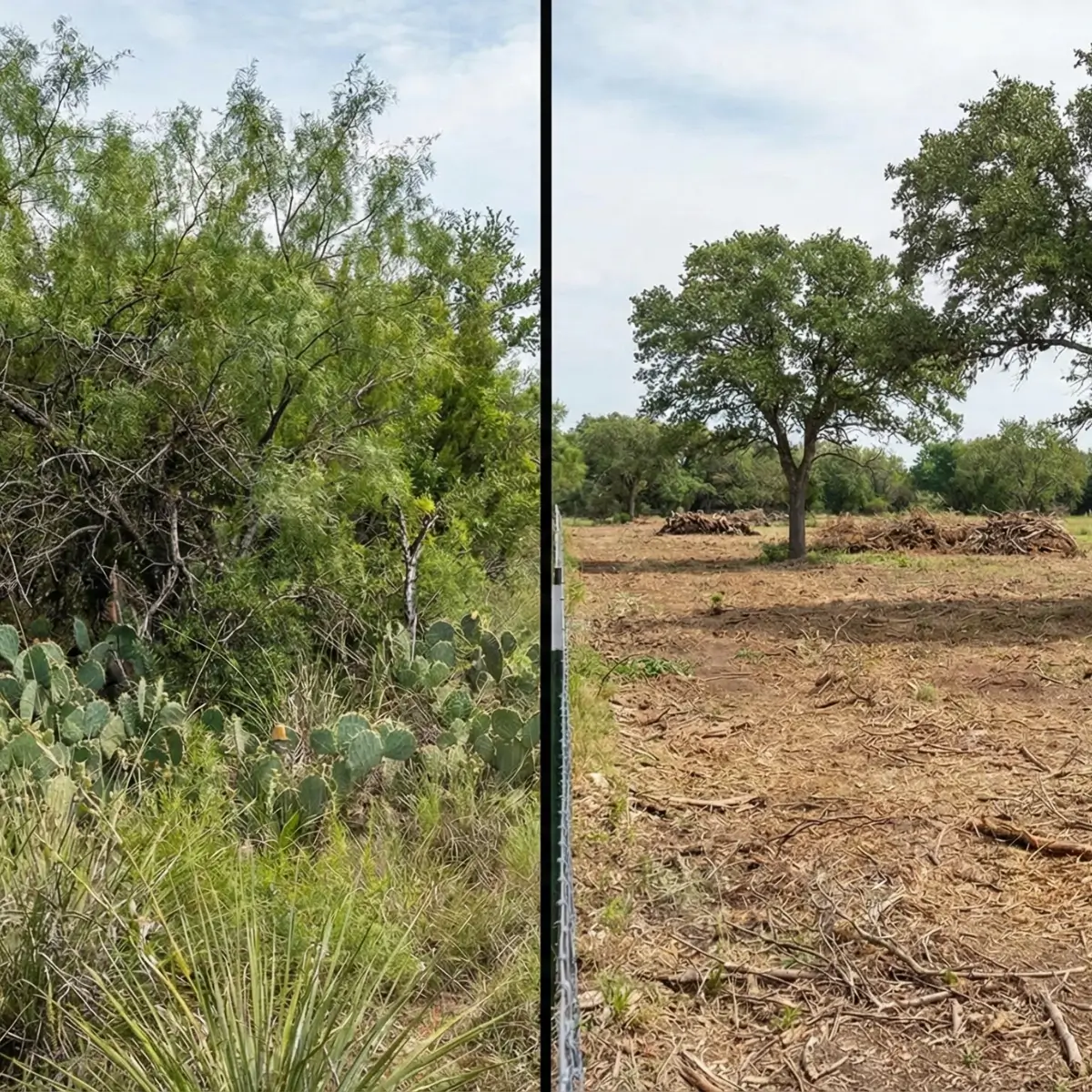
Mesquite, cedar and dense brush mulched back to usable pasture, with fire fuel load reduced and grazing recovered.

Driveways, access roads and utility corridors

Linear clearing for drives, ranch roads and utility easements, cut to the width the route actually needs.

Fence lines and property cleanup

Overgrown fence lines, property boundaries and neglected acreage cleared back to something maintainable.

Pre-construction clearing

Clearing as the first phase of a broader scope, handed straight into mass grading, excavation and erosion control.
The IRONWILL difference

How we approach clearing

Construction-first mindset

We clear to set up the next trade, not just to finish a clearing job.

Deliberate preservation

What stays is marked and protected before the first machine moves.

Method matched to the ground

Mulched where it can be, grubbed where it has to be — priced accordingly.

One team, full scope

Clearing, grading, pads, drainage and site prep under one contractor.
Service area

Land clearing across Dallas-Fort Worth and North Texas

We clear commercial, residential, industrial and rural property throughout North Texas, from single building envelopes to several hundred acres. Crews and equipment are based in Dallas, which keeps mobilization short across the region.
If your property is in or around the metroplex, ask — it is usually in range.
Allen
Lucas
Melissa
Richardson
Lewisville
The Colony
Prosper
Celina
Little Elm
Rockwall
Mesquite
Grapevine
Flower Mound
Weatherford
Kaufman
Waxahachie
Wylie
Sherman
Collin County
Send with your inquiry
→

Property address and approximate acreage

→

What you want kept — trees, buffers, sightlines

→

What the cleared area will be used for

→

Whether a survey or tree survey exists

→

Target schedule and site access limits

FAQ

Land clearing FAQ

What is land clearing?

Land clearing is the removal of trees, brush, stumps and vegetation from a property so it can be built on, accessed, farmed or maintained. On a construction site it is the first earthwork phase — the one that opens access, exposes the ground and sets the conditions every trade after it works in.

What is the difference between forestry mulching and grubbing?

Forestry mulching grinds standing brush and small trees into a mulch layer that is left on the ground; roots and the organic mat stay in place. Grubbing digs out stumps, root balls and the organic mat and hauls them away. Mulching is faster, cheaper and less disruptive; grubbing is the only one that leaves ground you can build structure on.

Can you build on mulched ground?

Not on anything structural. Mulch and the root mat underneath it are organic material, and organic material decomposes and settles. Building pads, pavement and structural fill areas have to be grubbed and stripped first. Mulching is the right answer for pasture, fire breaks, access corridors and anything that will stay vegetated.

Do I need a permit to remove trees in Dallas-Fort Worth?

Often, yes — and it varies by city. In Dallas, removing protected trees on commercial property requires a tree removal permit or a building permit and is subject to mitigation, while single-family and duplex lots under two acres are exempt. Other metroplex cities each have their own ordinance, protected tree sizes and mitigation formula, so the requirement should be confirmed for your specific address before anything comes down.

How do you protect the trees I want to keep?

Keep trees are identified and marked before mobilization, protection fencing is set at the critical root zone rather than at the trunk, and traffic, storage and stockpiling are kept outside it. Most tree loss on construction sites comes from compaction and root damage inside that zone, not from cutting, so the fence is the protection.

What happens to the cleared debris?

It depends on the method and the site. Mulched material stays on the ground as surface cover. Grubbed stumps, root balls and larger timber are chipped, consolidated or hauled off. Open burning is restricted across most of the metroplex and prohibited in many cities, so it is rarely the plan.

Can you clear selectively instead of taking everything?

Yes, and on most properties that is the better job. We walk and mark the line between keep and remove with you before mobilizing, then clear to it — preserving buffers, sightlines and specimen trees while opening up the area the project actually needs.

How much does land clearing cost?

Pricing comes from acreage, how dense and how large the vegetation is, how much of the site has to be grubbed rather than mulched, how the debris will be handled and how accessible the property is. Grubbing and haul-off cost considerably more per acre than mulching, which is why deciding method by area rather than for the whole site usually lowers the total.

How long does land clearing take?

Small residential lots are typically a matter of days. Larger commercial sites and acreage run from several days to several weeks depending on density, method and access. Wet ground is the usual delay, since heavy equipment on saturated soil does more damage than work.

Can clearing be combined with grading and site preparation?

Yes, and it is usually faster and cheaper that way. We handle clearing alongside grading, excavation, erosion control and site preparation so a property moves through to build-ready under one contractor without a second mobilization between phases.