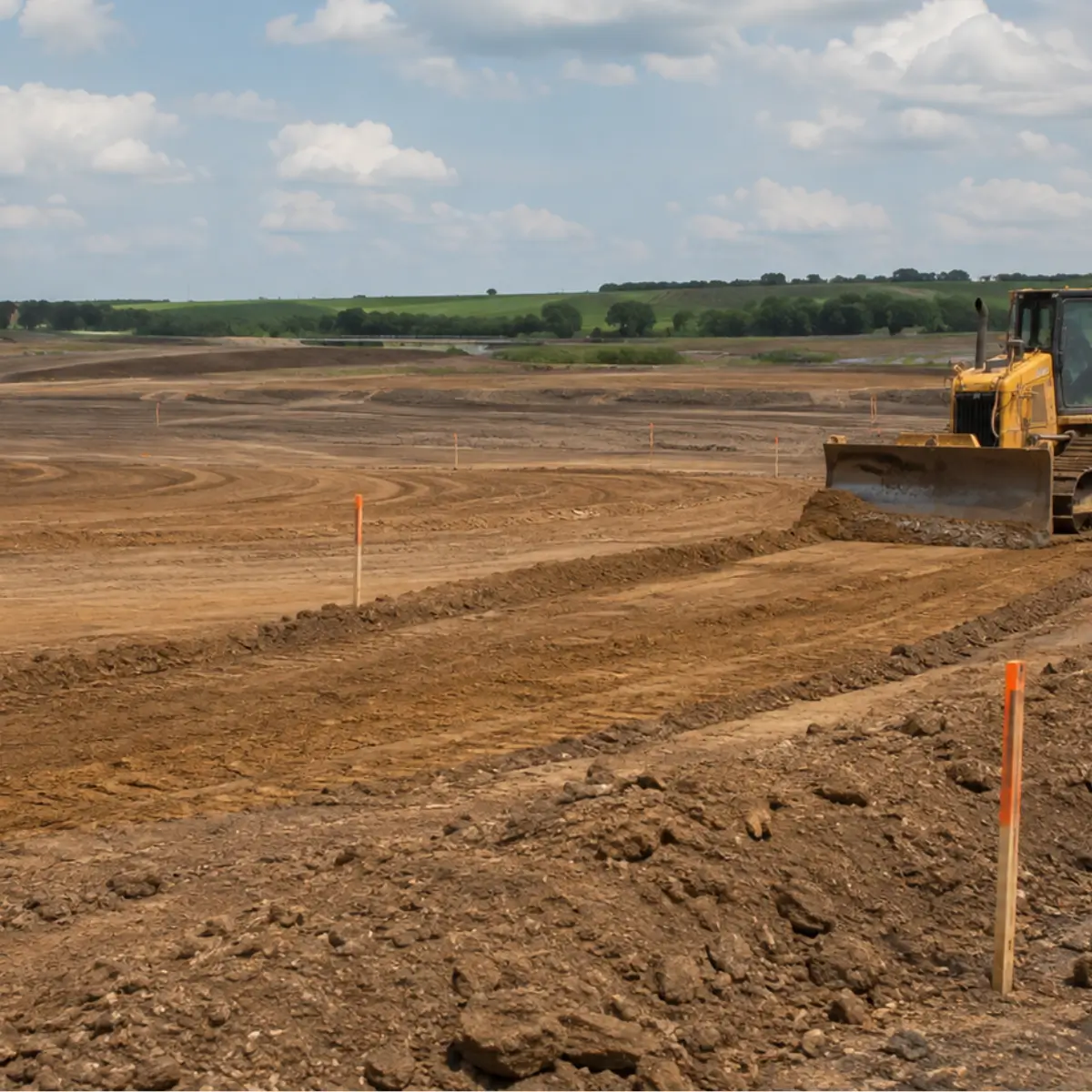
Pad Preparation · North Texas

Building Pad Preparation in Dallas-Fort Worth & North Texas

The slab is only as good as what it sits on. IRONWILL Earthworks builds structural building pads to the geotechnical report — undercut, moisture conditioning, lime and cement stabilization, select fill and imported aggregate base, compacted and proof-rolled to the density the engineer specified.
Moisture conditioning
Lime & cement stabilization
Select fill & aggregate import
Proof rolling
Geotechnical compliance
Built to the report

Not to a generic detail from another site

Moisture is the job

Conditioned and held, not sprayed and hoped

Stabilization done right

Lime, cement or select fill — matched to the soil

Testing-ready pads

Proof rolled before the lab truck arrives

Why it exists

A building pad is an engineered element, not a flat spot

Everything above the pad is designed. The slab thickness, the reinforcement, the bearing pressure, the tolerance for movement — all of it is calculated against an assumption about the ground underneath. Pad preparation is the work of making that assumption true.
North Texas makes it harder than most places. The metroplex sits on expansive clay that swells when it takes on water and shrinks when it dries, and the movement is measured in inches rather than fractions. A pad built at the wrong moisture content will pass a density test on Friday and heave the slab two years later. IRONWILL Earthworks is a North Texas earthwork contractor that builds pads to the geotechnical report rather than to the eye.
Below: what pad preparation actually includes, how it differs from grading, why moisture conditioning is the part that decides everything, which stabilization method suits which soil, and what gets tested before the pad is released. If you have a pad coming up, send us the geotechnical report.
Definition

What is building pad preparation?

Building pad preparation is the process of turning the ground beneath a structure into a uniform, engineered subgrade that will carry the design load without moving. It covers stripping and undercutting unsuitable material, conditioning the soil to a specified moisture content, stabilizing it with lime or cement or replacing it with select fill, placing imported aggregate base, and compacting each lift to the density the geotechnical engineer required.
The operative word is uniform. A pad does not fail because it is weak everywhere — it fails because one corner behaves differently from the rest. Soft material left in place under part of the footprint, a lift placed dry on one side and wet on the other, a stabilized zone that stops short of the slab edge: each of those produces differential movement, and differential movement is what cracks slabs and racks door frames.
That is why pad preparation is prescriptive work. Depth of undercut, moisture range, lift thickness, compaction percentage and the number of tests per lift are all specified in the geotechnical report, and the pad is not finished when it looks right — it is finished when the results say so.
Often confused

Pad preparation vs. grading — what’s the difference?

Grading gets the pad to the right elevation. Pad preparation gets it to the right condition. Only one of those is what the slab actually sits on.

Mass grading

Moving bulk volume to get the site to design elevations — cut, fill, haul and balance across the whole footprint. It establishes where the ground is, and it is measured in cubic yards.

Fine grading

Trimming the surface to line and grade within tight tolerance, usually just before concrete or paving. It establishes how flat the ground is, and it is measured in tenths of a foot.

Pad preparation — IRONWILL

Changing what the ground is made of and how it behaves — undercut, moisture conditioning, stabilization, select fill and compaction to a specified density. It establishes what the ground will do under load, and it is measured by the lab.
All three happen on the same site and often in the same week, and the sequence matters: mass grading brings the site to subgrade, pad preparation builds the structural section, and fine grading trims the finished surface. Problems start when a budget carries pad preparation as a line item inside grading — because the two are priced per cubic yard and per square foot respectively, and one of them includes lime, water trucks, mellowing time and testing.
Scope

What pad preparation includes

Every pad is different because every geotechnical report is different. These are the operations that make up the work, in the combination the soil and the structure call for.

Subgrade preparation and undercut

Stripping topsoil, organics and existing fill, then removing unsuitable material to the depth the report calls for. Anything that pumps under a loaded truck comes out before anything structural goes back in.

Moisture conditioning

Discing, watering or aerating the subgrade until the soil sits in the specified moisture window, then holding it there through compaction. On expansive clay this is the single most important operation on the pad.

Lime and cement stabilization

Chemical treatment to convert plastic clay into a workable, load-bearing platform — lime for high-PI clays, cement for granular and low-plasticity soils, mixed, mellowed and compacted to specification.

Select fill placement

Imported low-plasticity fill placed in controlled lifts where the native soil is not worth improving, giving the slab a predictable, non-expansive section to bear on.

Aggregate import and flexible base

Crushed limestone base and select aggregate hauled in, spread, moisture conditioned and compacted — the working surface for slab construction and the drainage layer under it.

Compaction and testing support

Lift-by-lift compaction with the right roller for the material, proof rolling ahead of the lab, and coordination with the testing firm so failing areas are reworked before they hold up the pour.
The part that decides everything

Moisture is what makes a pad work, and it is invisible

Soil reaches its maximum density at one specific moisture content. Compact it drier than that and the particles will not lock together; compact it wetter and the water carries the load instead of the soil. That value is established in the lab by a Proctor test — standard (ASTM D698) or modified (ASTM D1557) depending on the specification — and the field target is written as a percentage of that maximum dry density within a stated moisture range.
On North Texas clay there is a second reason to care. Expansive clay compacted dry has somewhere to go: it takes on water later, swells, and lifts the slab with it. That is why geotechnical reports in the metroplex so often require the subgrade to be placed and held above optimum moisture — the swell is taken out of the soil before the structure is built on it, rather than after. A pad that hits density but misses the moisture window has passed half a test.
The equipment reflects that. Water trucks, discs and reclaimers are not support equipment on a pad job, they are the primary equipment, and a pad that comes in too wet is dried by working it rather than by waiting for weather that may not arrive.

Optimum moisture established by Proctor, not by feel

Expansive clay usually placed wet of optimum on purpose

Disced and mixed full depth — not surface-watered

Aerated and dried when the soil comes in too wet

Moisture verified with the density test, lift by lift

Pad sealed and kept covered until the slab goes down

Methods

Stabilization methods and when each one applies

Stabilization is not one product applied to every pad. The method follows the soil, the structure and the schedule — and choosing the wrong one is expensive in both directions, whether that means treating soil that did not need it or building on soil that did.

Lime treatment

The standard answer for high-plasticity North Texas clay. Lime reacts with the clay to reduce plasticity, raise strength and produce a workable platform. Application rate is set by laboratory testing — commonly an Eades-Grim pH series (ASTM D6276), which identifies the percentage that holds the soil-lime mixture at a pH of about 12.4. Road-mixed lime treatment on Texas work is typically specified to TxDOT Item 260.

Cement treatment

Better suited to granular and low-plasticity soils, where cement builds strength directly rather than altering plasticity. It gains strength fast, which is an advantage on schedule and a constraint in the field — cement-treated material has to be mixed, shaped and compacted within a short window. Usually specified to TxDOT Item 275.

Select fill

Where the native soil is not worth improving, the answer is to replace it. Imported low-plasticity fill is placed over the prepared subgrade in controlled lifts, giving the structure a section that will not shrink and swell with the seasons. Often the preferred solution where the report calls for a non-expansive cap of a specific thickness.

Aggregate and flexible base

Crushed limestone base placed and compacted over the prepared subgrade, providing a stable working surface for slab construction, load distribution under the structure, and a drainage layer that keeps water from collecting at the subgrade. Flexible base material is commonly specified to TxDOT Item 247.
One local caution that belongs in every conversation about lime: soils carrying high soluble sulfate content can react with lime and water to form expansive minerals, producing heave rather than preventing it. Sulfate testing before treatment is cheap insurance, and where the numbers come back high the answer is a different method — cement, select fill or a thicker non-expansive cap. That determination belongs to the geotechnical engineer, and it starts with site analysis.
Verification

How a finished pad is verified

A pad is accepted on evidence, not appearance. These are the four things that decide whether it is ready for the structure — and the reason a schedule that skips mellowing time or testing turnaround is a schedule that will slip anyway.

The geotechnical report

The document the pad is built to. Borings, soil classification, plasticity index, swell potential and the recommendations that follow: undercut depth, moisture range, stabilization type and rate, lift thickness and required compaction. Everything else on this page is downstream of it.

Proof rolling

A loaded truck or heavy pneumatic roller driven across the prepared subgrade while it is watched. Areas that rut, pump or deflect are marked and reworked. It is the fastest way to find soft spots a test point would have walked straight past.

Density and moisture testing

Field density and moisture measured lift by lift against the Proctor maximum — typically by nuclear gauge (ASTM D6938) or sand cone (ASTM D1556). Both numbers matter: passing density at the wrong moisture is not a passing lift on expansive clay.

Potential vertical rise

PVR estimates how much the soil profile could heave if it takes on water, and it is what usually drives the required depth of moisture conditioning, treatment or select fill. In Texas it is commonly calculated using test method Tex-124-E.
How it works

Our pad preparation process

Pad preparation is sequential work, and the sequence is not negotiable — every step depends on the one before it being right. This is the order we work in, and where the schedule time actually goes.
01

Review the geotechnical report

We start with the report, not the plan sheet. Undercut depth, moisture range, stabilization type and rate, lift thickness, compaction percentage and PVR recommendations set the entire sequence and most of the cost.
02

Strip, undercut and proof roll

Topsoil, organics and existing fill come off. Unsuitable material is undercut to the specified depth and the exposed subgrade is proof rolled so soft areas are found and removed before anything structural is placed on them.
03

Moisture condition the subgrade

The subgrade is disced, watered or aerated full depth until it sits inside the specified moisture window — commonly above optimum on expansive clay — and held there through compaction rather than dried out overnight.
04

Stabilize or import fill

Lime or cement spread at the tested rate, mixed full depth, mellowed for the required period and remixed — or select fill and aggregate base hauled in and placed where replacement is the specified solution.
05

Compact in lifts and test

Material placed in lifts of the specified thickness and compacted with the right roller for the material. Density and moisture are tested lift by lift; anything that fails is reworked and retested before the next lift goes on.
06

Finish, protect and hand over

The pad is trimmed to grade and tolerance, sealed against rain, and drainage is kept moving away from it. A finished pad that ponds water for a week is not a finished pad, so it is protected until the slab goes down.
Why it matters

What a properly built pad prevents

Pad failures rarely show up during construction. They show up in year two and year three, as cracks running diagonally from slab corners, doors that stop latching, brick that separates at the joints and floors that read out of level on a laser. By then the fix is not earthwork — it is piers, mudjacking and litigation.
Almost all of it traces back to differential movement: one part of the pad moving relative to another. Uniform moisture, uniform material and uniform compaction are the whole defense, and they cost a fraction of what remediation costs. This is the least glamorous line item on the site work budget and the one most likely to be regretted if it is cut.
There is a schedule argument too. A pad that passes testing the first time releases the slab on the date the pour was scheduled, and everything stacked behind that pour — framing, envelope, inspections — keeps its sequence.

Uniform bearing across the whole slab footprint

Swell potential taken out before the structure goes up

Density and moisture documented for the record

Slab pours that are not waiting on a failed test

Fewer differential-movement cracks years later

A working surface crews can build on in any weather
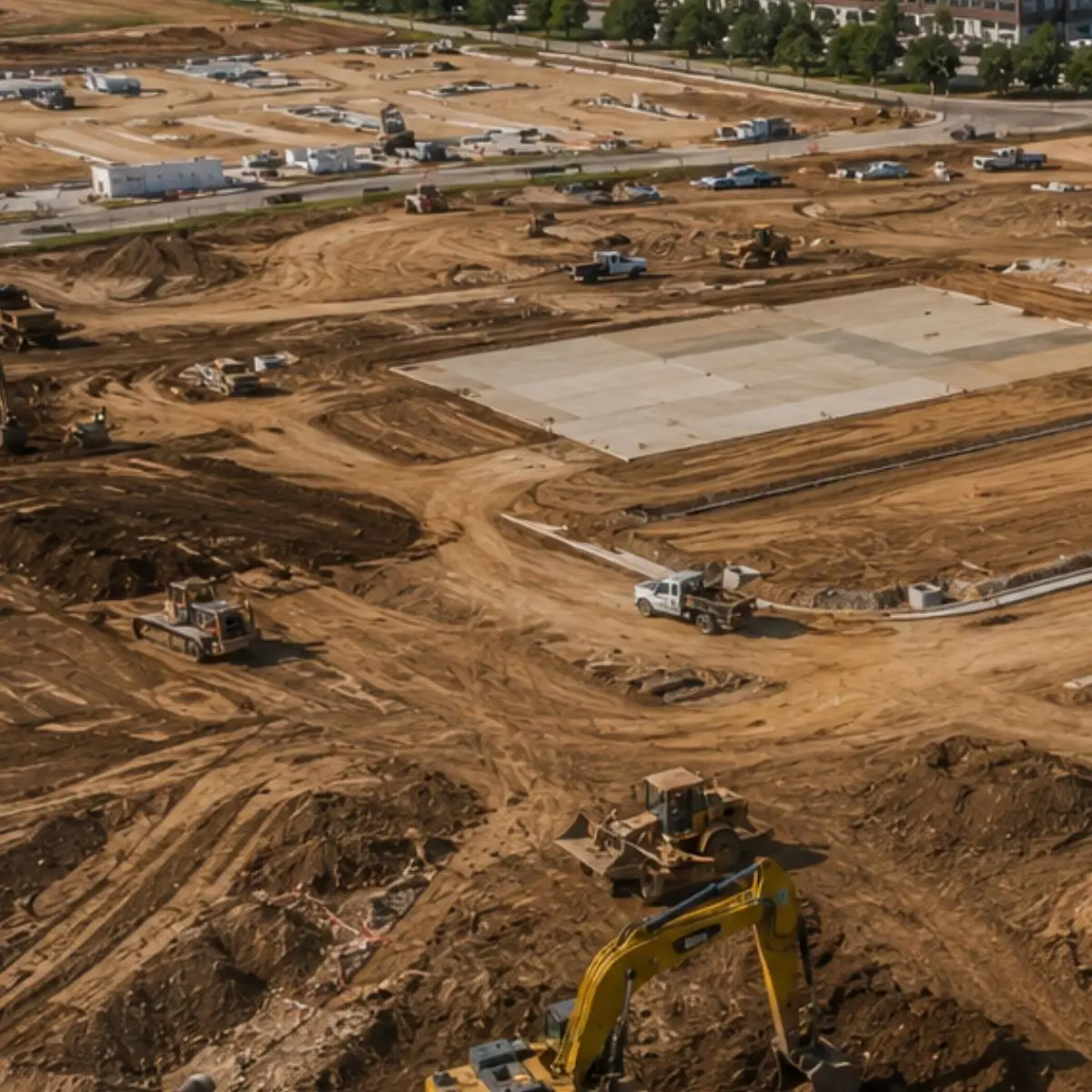
Have a pad to build?

Send the geotechnical report and the pad footprint. We will tell you what the undercut, moisture conditioning, stabilization and imported material actually cost — and how many days the mellowing and testing add to the schedule.
Who we work for

Pads we build

From a single equipment foundation to a warehouse floor covering several acres, the question is the same: what does the report require, what is the soil actually doing, and what has to be true before the concrete arrives.

Commercial buildings and retail

Slab-on-grade pads for offices, retail shells, restaurants and medical buildings, where finish tolerances are tight and the slab is the floor everyone sees.

Industrial and warehouse floor slabs

Large-footprint pads carrying racking loads and forklift traffic, where flatness and uniform bearing across hundreds of thousands of square feet is the entire specification.

Multifamily and residential

Building pads for apartments, townhomes and single-family construction on expansive clay, where post-tension slabs still depend on what the subgrade does.

Tilt-wall and structural pads

Pads that have to serve twice — as a casting surface for tilt-wall panels and as the finished floor section afterward.

Equipment and tank foundations

Smaller, heavily loaded pads for equipment bases, tanks and process structures where settlement tolerance is measured in fractions of an inch.

Municipal and institutional

Pads for public buildings, schools and civic facilities, built and documented to the testing regime the owner’s program requires, often under construction management.
The IRONWILL difference

How we approach pad preparation

Built to the report

The geotechnical recommendations drive the work, not a detail borrowed from the last job.

Moisture taken seriously

Water trucks, discs and mellowing time budgeted as real scope, not as an afterthought.

North Texas clay experience

Expansive soil is what we work in every day, including where lime is the wrong answer.

Testing coordinated, not dreaded

Proof rolled before the lab arrives, failures reworked immediately, results documented.
Service area

Pad preparation across Dallas-Fort Worth and North Texas

We build structural building pads on commercial, industrial, multifamily and municipal sites throughout North Texas — the same expansive clay, the same testing regime, the same weather window. Crews, water trucks and compaction equipment are based in Dallas.
If your site is in or around the metroplex, ask — it is usually in range.
Allen
Lucas
Melissa
Richardson
Lewisville
The Colony
Prosper
Celina
Little Elm
Rockwall
Mesquite
Grapevine
Flower Mound
Weatherford
Kaufman
Waxahachie
Wylie
Sherman
Collin County
Send with your inquiry
→

Site address and pad footprint

→

Geotechnical report, if you have one

→

Required compaction and moisture range

→

Structure type — slab, tilt-wall, equipment

→

Target date for the slab pour

FAQ

Pad preparation FAQ

What is building pad preparation?

Building pad preparation is the process of turning the ground beneath a structure into a uniform, engineered subgrade that will carry the design load without moving. It includes stripping and undercutting unsuitable material, conditioning the soil to a specified moisture content, stabilizing it with lime or cement or replacing it with select fill, placing imported aggregate base, and compacting each lift to the density the geotechnical engineer required.

How is pad preparation different from grading?

Grading changes where the ground is; pad preparation changes what the ground is made of and how it behaves. Mass grading moves bulk volume to reach design elevations and fine grading trims the surface to tolerance, but neither one alters the soil’s moisture, plasticity or bearing capacity. Pad preparation is the work that makes the subgrade match what the structural design assumed.

Why does moisture conditioning matter so much on a building pad?

Soil reaches maximum density at one specific moisture content, established in the lab by a Proctor test. Compacted drier than that, it will not lock together; compacted wetter, the water carries the load instead of the soil. On expansive North Texas clay there is a second reason: clay compacted dry has room to swell later, so geotechnical reports often require the subgrade to be placed and held above optimum moisture, taking the swell out before the structure is built.

What compaction is typically required for a building pad?

It is set by the geotechnical report rather than by a universal rule, but a common specification is 95 percent of the standard Proctor maximum dry density (ASTM D698) within a stated moisture range, with modified Proctor (ASTM D1557) used where higher densities are called for. Both the density and the moisture have to be inside the specified range for the lift to pass.

When is lime stabilization used instead of cement?

Lime is used on high-plasticity clay, where it reacts with the clay minerals to reduce plasticity and produce a workable, stronger platform. Cement is better suited to granular and low-plasticity soils, where it builds strength directly. On Texas projects road-mixed lime treatment is commonly specified to TxDOT Item 260 and cement treatment to Item 275.

How is the lime application rate determined?

By laboratory testing, not by rule of thumb. The usual method is an Eades-Grim pH series (ASTM D6276), in which increasing percentages of lime are mixed with the soil and the pH measured; the design rate is the lowest percentage that holds the mixture at a pH of about 12.4, which is the condition the stabilizing reaction needs.

Can lime ever make a pad worse?

Yes, and it is a real risk in parts of North Texas. Soils with high soluble sulfate content can react with lime and water to form expansive minerals, causing heave instead of preventing it. Sulfate testing before treatment is inexpensive, and where the results come back high the answer is a different approach — cement stabilization, select fill, or a thicker non-expansive cap.

What is select fill and when is it used?

Select fill is imported low-plasticity soil placed in controlled lifts over a prepared subgrade. It is used where the native soil is not worth improving, or where the report calls for a non-expansive cap of a specified thickness beneath the slab, giving the structure a section that will not shrink and swell with seasonal moisture.

What is proof rolling and why is it done?

Proof rolling is driving a loaded truck or heavy pneumatic roller across the prepared subgrade while it is observed. Areas that rut, pump or visibly deflect are marked, undercut and reworked. It finds soft spots between test locations, which is exactly where a density test would otherwise miss them.

How long does pad preparation take?

It depends on the footprint and the method, but the schedule is usually driven by chemistry and testing rather than by earthmoving. Lime treatment requires a mellowing period between mixing and final compaction, density and moisture testing has to come back before the next lift is placed, and rain can put a clay pad out of its moisture window for days. Those items belong on the schedule from the start.