

Industrial · Texas and Oklahoma

Industrial Earthwork Services Across Texas and Oklahoma

Industrial sites are measured in acres and in hundreds of thousands of cubic yards, and the slab that goes on them is measured in hundredths of an inch. IRONWILL Earthworks delivers the mass grading, building pads, paving subgrade and drainage that manufacturing plants, distribution centers, cold storage and data centers are built on, across the whole footprint and in the order the program releases it.

Manufacturing
Distribution & logistics
Industrial parks
Data centers
Large-scale grading
Built for scale

Acres, not lots, and the fleet to match

GPS machine control

One design surface held across the whole footprint

Heavy-load sections

Truck courts and rail roadbed built to their own specifications

Phased to the program

Early pads released while grading continues

Why it matters

At industrial scale, small errors are multiplied by the acre

A tenth of a foot out of tolerance on a small pad is a nuisance. Across a floor slab of several hundred thousand square feet it is thousands of yards of concrete out of place, and it shows up in the numbers the owner will measure. ASTM E1155 quantifies a finished floor's flatness and levelness as FF and FL numbers1, racking, automated storage and forklift traffic are all specified against those numbers, and a slab cannot be flatter than the subgrade beneath it is uniform. Industrial earthwork is the same work as any other site, done at a scale where uniformity matters more than anything else about it.

IRONWILL Earthworks partners with developers, general contractors and industrial owners across Texas and Oklahoma on greenfield builds and expansions. Our crews run GPS-guided equipment, build the whole footprint to one design surface and check grade against it in the field as we go, so the pad under the last column line is built to the same model as the first, and a miss is found the day it happens rather than at the end.

The other constraint is loading. Industrial pavement carries loaded trailers, container handlers and constant truck traffic, and an industrial specification more often calls for modified Proctor compaction: the ASTM D1557 test applies 56,000 foot-pounds per cubic foot, four and a half times the standard effort, with a ten pound rammer dropped eighteen inches2. A subgrade compacted to a percentage of that maximum is denser than a retail parking lot ever sees, and it is proven lift by lift with a nuclear gauge to ASTM D69383.

Scope

Earthwork for industrial sites, from the first acre to the last pad

Industrial developments involve very large grading quantities, heavy pavement, deep process utilities and pads that go to different tenants at different times. That is the list of scopes an industrial site actually needs from us.

Balance and haul studied across the whole site before the bid, because on two hundred acres the difference between a balanced site and an imported one is the whole schedule.

Complete clearing of former farmland and pasture, with the fence lines, stock tanks and old foundations that come with it.

Removal of the plant, slabs and rail of a previous industrial use, with the surveys and notices demolition requires done first.

Bulk cut and fill across the whole footprint, with embankment placed in lifts and each lift tested before the next goes on.

Building pads of several acres built to one uniform section, so the slab's flatness numbers are achievable from the first pour to the last1.

Truck courts, trailer storage and fire lanes on the heavier sections the geotechnical report assigns to them, with base placed and tested before paving.

Support for deep pits, dock walls and excavations beside an existing plant, engineered wherever an adjoining structure would be endangered9.

Controls sized for a site that may stay open a year or more, with the SWP3 kept current as phases are released6.

Pad release sequence, haul road plan, testing coordination and the daily production record a phased program runs on.

Every scope also covers the work that does not get its own page: storm drainage structures and their backfill, rough and final grading, stabilization, import and export of material, and the haul roads that let the rest of the site keep moving. On an industrial site it is sequenced around production, because the paving crew cannot start until the base is accepted and the slab cannot start until the pad is.

What you get

How a staged industrial site is delivered

Industrial schedules run on production: yards per day, pads released per week, and a paving crew that cannot start until the base is tested and accepted. The earthwork is shaped by what will stand on it, facility by facility.

What the earthwork has to deliver, by the kind of facility that will stand on it.
FacilityWhat the earthwork must deliverWhat governs it
Distribution and logisticsOne floor slab across hundreds of thousands of square feet with flatness and levelness the owner will measure, and truck courts and trailer storage on the heavy pavement sectionASTM E1155 FF and FL numbers1; the geotechnical report's pavement sections
ManufacturingEquipment pads and pits at different elevations inside one footprint, with process utilities deep beneath themFederal excavation rules where a cut runs below an adjoining footing9; the report's fill requirements
Cold storageA pad with no soft spot anywhere under a slab that will carry insulation, a heated subfloor and racking to the roofASTM E11551; proof rolling over the whole footprint
Data centersSeveral building pads plus generator and switchgear yards released in sequence, and detention sized for a very large roofThe pad release schedule; the region's iSWM stormwater criteria10
Rail-served sitesA spur roadbed built to the railroad's standard: the top three feet of subgrade at 95 percent of the modified maximum density, moisture within three percent of optimum, every lift tested before the next, proof rolled before subballastUnion Pacific Industrial Track Specifications4; ASTM D15572; ASTM D69383
Any of them, once operatingYards graded so stormwater from material storage and loading areas is manageable under the owner's own permitTCEQ Multi-Sector General Permit TXR0500007

Safety on a site this size is a production issue as well as a compliance one. Large crews, heavy haul traffic and deep utility work share one footprint, so the plan that keeps them apart exists before the first machine tracks onto the site: utility locations determined and the owners contacted before any excavation is opened, a competent person inspecting every excavation daily and after rain, and haul routes that never cross an active pad9. Dust is regulated as well. Texas prohibits discharging any air contaminant in a concentration and duration that interferes with the normal use and enjoyment of property8, and a two hundred acre grade in August produces exactly that unless the water trucks are running.

Grade held across the full footprint from one design surface

Pads released in the order the program needs them

Foremen who are OSHA 30 certified and Certified CAT Operators

Utility locates, daily inspections and haul routes planned before mobilization

Modern GPS-guided construction equipment

Density, moisture and elevation records by pad and by lift

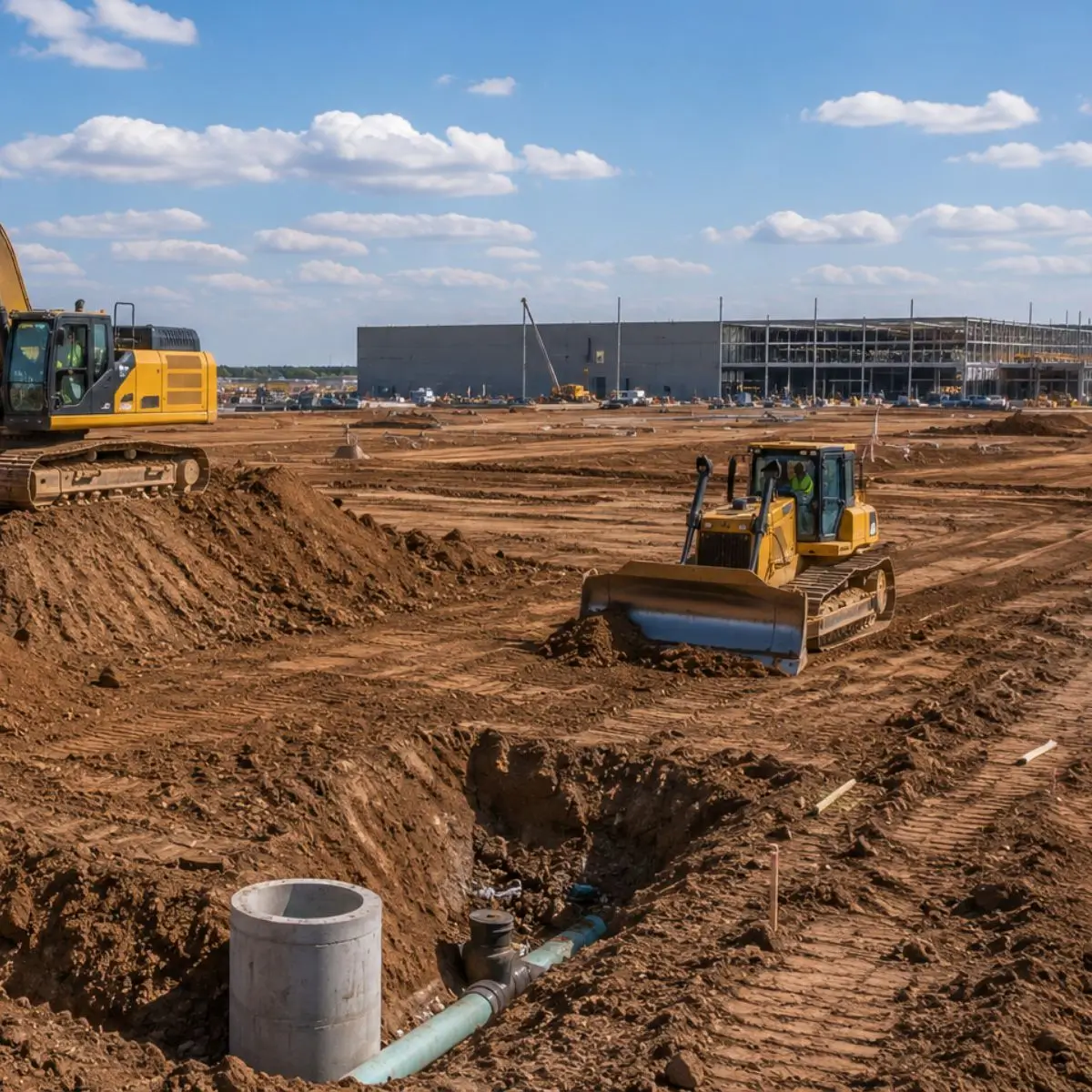
Excavator setting a concrete manhole beside a warehouse
Who we build for

Industrial projects we support

We provide earthwork for industrial development across Texas and Oklahoma, whether the project spans several acres or several hundred, and whether it is one building or a park delivered over years.

Manufacturing facilities
Distribution centers
Warehouses
Logistics facilities
Industrial parks
Flex industrial buildings
Cold storage facilities
Processing plants
Data centers
Utility infrastructure
Industrial expansions
Heavy commercial facilities

Two of them carry specifications of their own. A rail-served site's spur is built to the railroad's standard: on a Union Pacific industry track the top three feet of subgrade are compacted to at least 95 percent of the ASTM D1557 maximum density, material below that to 90 percent, moisture is held within three percent of optimum, every lift is tested before the next is placed, and the finished subgrade is proof rolled before subballast goes down4. And once the plant is running, stormwater from its material storage and loading areas may need the owner's own coverage under the state's Multi-Sector General Permit, TXR050000, whose new term begins August 14, 20267. We grade the yards so that permit is easier to keep.

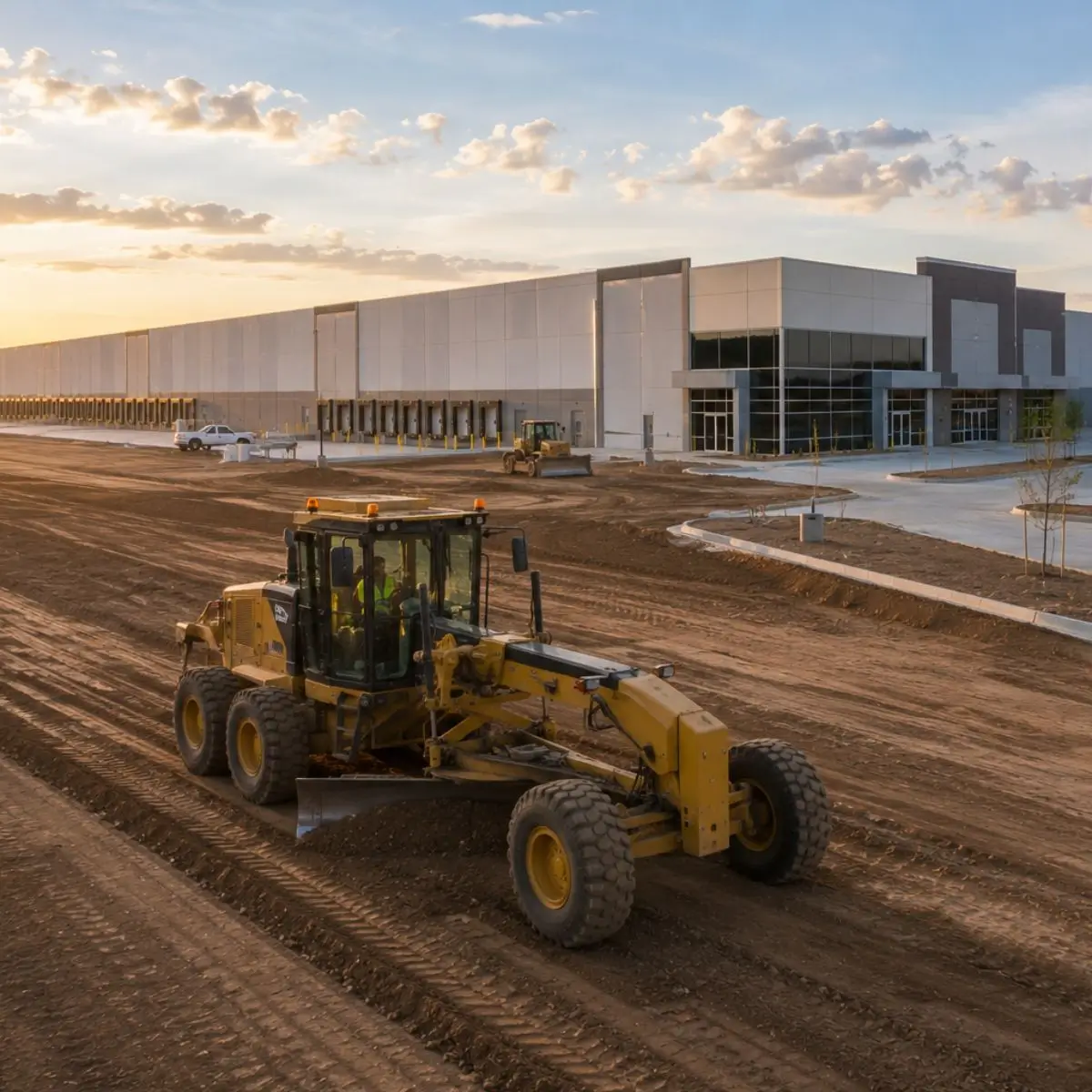
Motor grader finishing the yard in front of a new distribution warehouse

Planning an industrial development?

Send the civil plans, the geotechnical report and the phasing you have in mind. We will come back with earthwork quantities, a pad release sequence, and what the testing and treatment actually add to the schedule.

Service area

Industrial site work across Texas and Oklahoma, from Dallas-Fort Worth

We support industrial construction throughout the metroplex and the logistics corridors around it, along I-35, I-45 and I-20 and north through Collin, Denton and Grayson counties, and across Texas and Oklahoma beyond them. Crews and equipment are based in Dallas.

A large industrial footprint pulls equipment and water trucks for months, so ask early and we will tell you what we can staff and when.

Dallas
Fort Worth
Plano
McKinney
Frisco
Allen
Lucas
Melissa
Richardson
Carrollton
Lewisville
Denton
The Colony
Prosper
Celina
Little Elm
Rockwall
Garland
Mesquite
Arlington
Grapevine
Flower Mound
Irving
Weatherford
Kaufman
Waxahachie
Wylie
Sherman
Greenville
Collin County
Send with your inquiry
→

Site address and total acreage

→

Civil plans and geotechnical report

→

Building footprint and floor slab area

→

Required pavement section

→

Phasing and target pad release dates

FAQ

Industrial earthwork FAQ

What types of industrial projects does IRONWILL Earthworks support?

Manufacturing plants, warehouses, distribution and logistics centers, industrial parks, flex buildings, cold storage, processing plants, data centers, rail-served sites and expansions of existing plants across Texas and Oklahoma.

Can you handle large-scale industrial earthwork?

Yes. Large industrial sites are what our fleet and crews are organized around: bulk grading in the hundreds of thousands of cubic yards, building pads covering several acres, storm systems and phased delivery that releases early pads while grading continues elsewhere. Where a report specifies select material for the pad, TxDOT's Type A embankment, with a liquid limit of 45 or less and a plasticity index of 15 or less, is the kind of definition it usually points to5.

Do you provide complete industrial site preparation?

Yes: clearing, selective demolition, excavation, mass grading, pad preparation, paving subgrade and flexible base, storm drainage, excavation support, erosion control and final grading, as one scope rather than split across subcontractors.

How is an industrial floor slab pad different from a commercial one?

Mostly in uniformity and in the compaction standard. An industrial slab is specified to flatness and levelness numbers under ASTM E11551, and the subgrade has to behave the same at every point beneath it, so the pad usually gets deeper treatment or select fill, proof rolling across the whole footprint rather than spot checks, and compaction measured against the modified Proctor curve rather than the standard one2.

Do you build the truck courts and heavy-duty pavement too?

Yes. Truck courts, trailer parking and fire lanes take the heaviest loading on the site and are prepared to a heavier section than the car park: treated subgrade where the report calls for it, thicker flexible base, and density proven with a nuclear gauge before paving3.

What areas do you serve?

Industrial construction across Texas and Oklahoma from our Dallas base, including Dallas, Fort Worth, Plano, Frisco, McKinney, Allen, Prosper, Celina, Denton, Sherman, Greenville and the surrounding communities.

Sources

Every number and every rule on this page is cited here. Reviewed September 17, 2026.

  1. ASTM E1155, Standard Test Method for Determining FF Floor Flatness and FL Floor Levelness NumbersASTM InternationalThe F-numbers an industrial floor slab is specified and accepted on.
  2. ASTM D1557, Standard Test Methods for Laboratory Compaction Characteristics of Soil Using Modified Effort (56,000 ft-lbf/ft3)ASTM InternationalThe modified Proctor curve: 56,000 foot-pounds per cubic foot, a ten pound rammer dropped eighteen inches, and the maximum dry unit weight heavy-duty subgrade is measured against.
  3. ASTM D6938, Standard Test Methods for In-Place Density and Water Content of Soil and Soil-Aggregate by Nuclear Methods (Shallow Depth)ASTM InternationalThe nuclear gauge test used for acceptance of compacted fill and base.
  4. Industrial Track SpecificationsUnion Pacific RailroadMoisture, compaction and testing for track subgrade: 95 percent of ASTM D1557 maximum in the top three feet, 90 percent below, moisture within three percent of optimum, each lift tested before the next, proof rolling before subballast.
  5. 2024 Standard Specifications for Construction and Maintenance of Highways, Streets, and BridgesTexas Department of Transportation, 2024Item 132, Embankment: the Type A select material limits (liquid limit 45 or less, plasticity index 15 or less).
  6. Stormwater General Permit for Construction Activities (TPDES General Permit TXR150000)Texas Commission on Environmental QualityThe SWP3 required before construction begins and maintained through it.
  7. Stormwater Multi-Sector General Permit for Industrial Facilities (TXR050000)Texas Commission on Environmental QualityThe owner's permit for stormwater from manufacturing, processing, material storage and loading areas once the plant is operating; the 2026 permit's August 14, 2026 effective date and its renewal window.
  8. Texas SIP: 30 TAC 101.4, Nuisance (General Air Quality Rules)U.S. Environmental Protection AgencyThe text of the Texas nuisance rule that governs construction dust.
  9. 29 CFR 1926.651, Specific Excavation RequirementsCode of Federal Regulations, U.S. Government Publishing Office, 2023Paragraph (b), utility locations determined and owners contacted before an excavation is opened; paragraph (i), support where an excavation endangers an adjoining structure or runs below a footing; paragraph (k), daily inspection by a competent person.
  10. Integrated Stormwater Management (iSWM) Program for Construction and DevelopmentNorth Central Texas Council of GovernmentsThe regional stormwater criteria detention on a large site is drawn to.