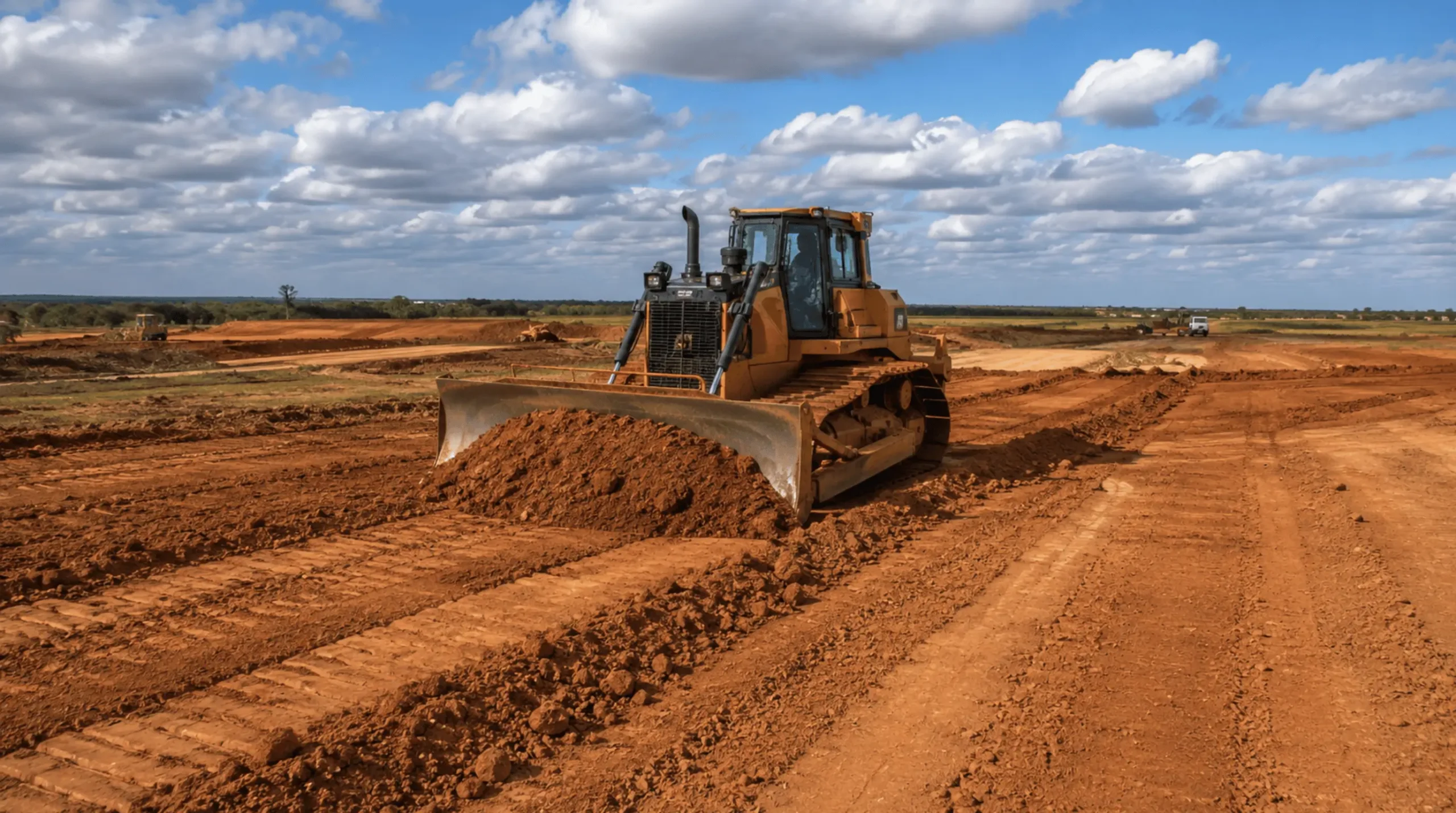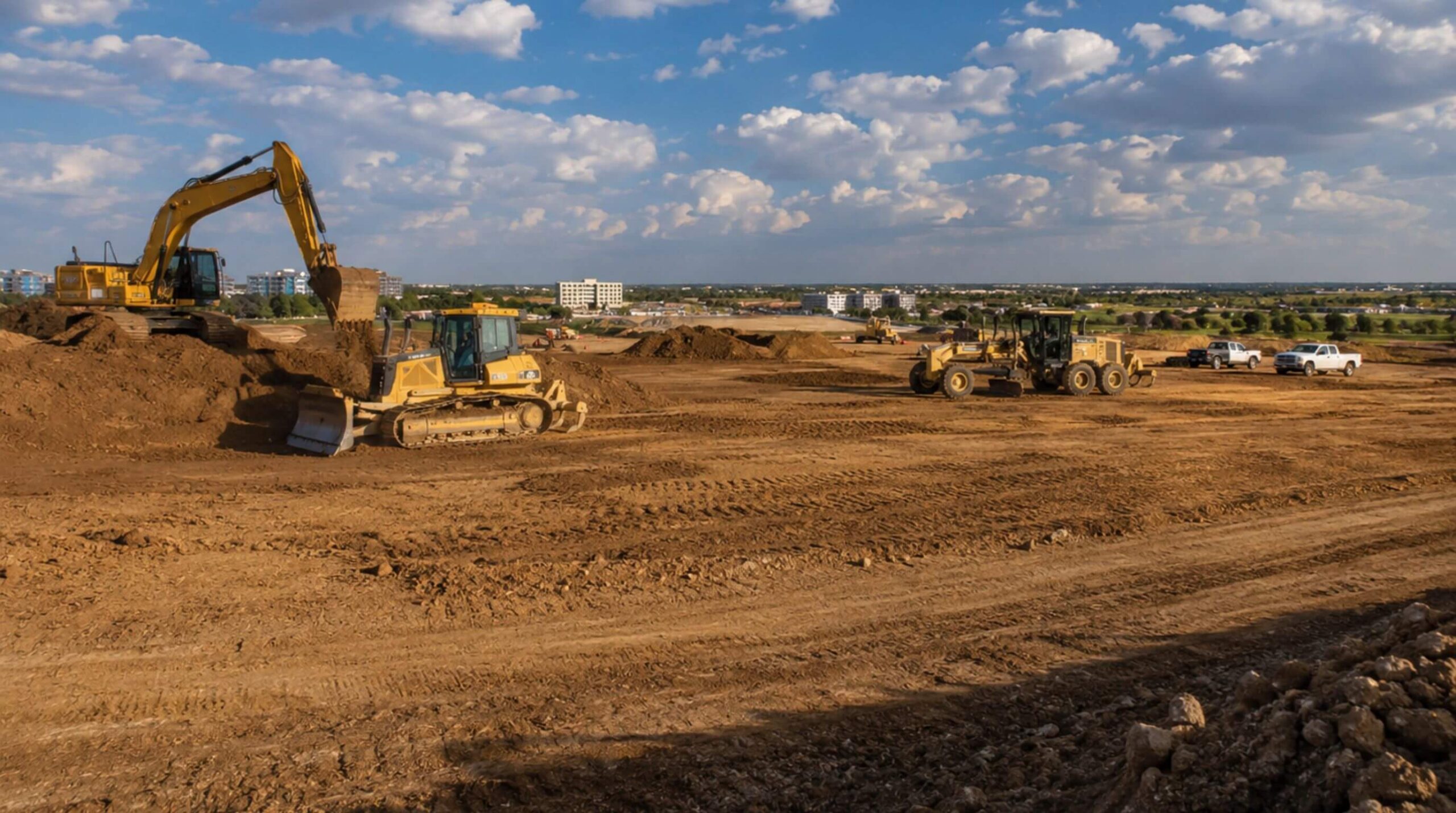

Scale does not change the physics of moving dirt. It changes the arithmetic, and it changes who is watching. A two-acre pad and a two-hundred-acre business park are graded with the same machines, tested against the same laboratory curve and drained under the same rules. The difference is that at scale every small error is multiplied by the quantity, every truck is one of hundreds on a public road, and the state's permit, the city's inspector and the owner's testing laboratory all arrive with a longer checklist. This is what actually changes when earthwork gets large in North Texas, with the rule behind each change.
The permit draws the line at five acres
Texas defines large construction activity as clearing, grading and excavating that disturbs five or more acres, or less than five acres inside a larger common plan of development that will1. A large site files a Notice of Intent rather than posting a site notice, and once ten or more acres are disturbed at one time and drain to a common location, a sediment basin or similar impoundment is required where feasible, sized to hold the runoff of a 2-year, 24-hour storm from every disturbed acre1. On a big site the basin is part of the mass grading plan, not an afterthought: it is dug first, it holds the site's water for the whole job, and it is often the future detention pond with a temporary outlet.
Balance is a bigger number, not a different idea
The takeoff on a large site is the same cut and fill calculation as on a small one, with two differences of degree. The first is how the quantities are paid. TxDOT's Item 110 measures excavation by the cubic yard in its original position, computed by the method of average end areas, as a plans quantity, and states that shrinkage or swelling factors will not be considered in determining the calculated quantities3. Item 132 makes shrinkage or swell factors the contractor's responsibility and allows embankment to be measured three ways: in its final position, in its original position, or in vehicles at the point of delivery2. A private contract may use any of those bases, and at half a million cubic yards the choice of basis is worth more than most change orders. The second difference is the balance itself. A large site rarely balances by accident, so the takeoff, the shrink and swell factors from the geotechnical report and the phasing plan are what say whether trucks are the exception or the plan.
Survey control is the foundation under the foundation
Everything on a large site is positioned relative to control, and control has a datum. TxDOT's survey manual references its work to the National Spatial Reference System, uses the North American Datum of 1983 for horizontal positions and ellipsoid heights and the North American Vertical Datum of 1988 for orthometric heights, and requires control coordinates to be provided in both surface and grid values using the stated surface adjustment factor7. That surface-to-grid distinction is the one that bites at scale: a model built on grid coordinates and a machine reading surface coordinates disagree by a few hundredths of a foot per thousand feet, which is nothing on a pad and a real error across a mile of roadway. The National Geodetic Survey, which defines those datums, has announced new datums aligned to the International Terrestrial Reference Frame to replace NAD 83 and NAVD 888, so the control on a multi-year project should record which datum it was set in. We set and check control before the first machine unloads, and we do not let two surveyors' control coexist on one site.
Machine control replaces the stakes
On a large site the design surface lives in the machine. The Federal Highway Administration describes automated machine guidance as construction equipment with onboard computers that use 3D engineered models and GPS to give operators horizontal and vertical guidance in real time, with the potential to reach designed grades on the first pass rather than against stakes, productivity gains of up to 50 percent on some operations, and survey cost reductions of as much as 75 percent6. The gain is not speed alone. A blade that reads the model does not wait for a grade checker, and a site with no stakes has nothing for a truck to knock down. On our sites the grade is checked in the field with GPS and laser equipment against the same model the civil engineer built, so a miss is found the day it happens rather than at the end.
Drones measure what the machines did
Quantities on a big site are verified from the air. A small unmanned aircraft under 14 CFR Part 107 weighs less than 55 pounds at takeoff, is flown by the holder of a remote pilot certificate with a small UAS rating or under that person's direct supervision, must stay within visual line of sight, may not fly higher than 400 feet above ground level except within 400 feet of a structure, may not exceed 100 miles per hour, and needs at least 3 statute miles of visibility from the control station9. A survey-grade flight over a graded site produces a surface that can be compared with last week's, which is how stockpiles, cut volumes and pay quantities get measured monthly instead of argued about at the end. The surface still has to be tied to the same control as the machines, on the same surface or grid basis7, or the drone quietly measures a different site.
Lifts, moisture and proof, multiplied
The fill rules do not relax because there is more fill. TxDOT's embankment item limits a layer under ordinary compaction to 8 inches loose, and under density control to 16 inches loose or 12 inches compacted, with the maximum dry density and optimum moisture set by Tex-114-E and the field density measured by Tex-115-E2. Its acceptance table is a plain statement of what North Texas clay demands. Material with a plasticity index of 15 or less is compacted to at least 98 percent of maximum density; from 15 to 35 it must sit between 98 and 102 percent at or above optimum moisture; above 35 it must sit between 95 and 100 percent, again at or above optimum; and once placed, the moisture of any soil with a PI over 15 may not fall more than 4 percent below optimum2. The laboratory curve those percentages refer to is the standard-effort compaction test, ASTM D698, which drops a 5.5 pound rammer 12 inches to deliver 12,400 foot-pounds per cubic foot and reports the optimum water content and maximum dry unit weight of the sample4. In the field the nuclear gauge of ASTM D6938 measures in-place density and water content to a depth of 12 inches, rapidly and without disturbing the lift, which is what makes hundreds of tests a month possible5. At scale the testing program is a logistics problem: the technician has to be where the lift is, and a lift that waits for a test is a lift drying in the sun.
| Plasticity index of the fill | Density required, Tex-115-E | Moisture required |
|---|---|---|
| PI of 15 or less | At least 98 percent of maximum dry density2 | None stated2 |
| PI over 15, up to 35 | 98 to 102 percent of maximum dry density2 | At or above optimum2 |
| PI over 35 | 95 to 100 percent of maximum dry density2 | At or above optimum2 |
| Any fill with PI over 15, after placement | Maintained until the next lift2 | Never more than 4 percent below optimum2 |
Trucks on public roads are a regulated part of the job
A large site that imports or exports material puts hundreds of loads a day on public roads, and the limits are statute. Texas Transportation Code Chapter 621 caps a single axle at 20,000 pounds and a tandem at 34,000, computes the allowable weight on any group of axles by the bridge formula W = 500((LN/(N minus 1)) + 12N + 36), and caps overall gross weight at 80,000 pounds regardless of axle count or spacing10. Width is capped at 102 inches and height at 14 feet, and the owner of a vehicle is strictly liable for damage to a bridge or underpass caused by its height10. The Texas Department of Motor Vehicles restates the limits, 20,000 single, 34,000 tandem, 42,000 triple, 80,000 gross, 8 feet 6 inches wide and 14 feet high11, and issues the oversize and overweight permits and authorized routes that scrapers, dozers and excavators need to reach the site on a lowboy12. On a big job the haul route, the permit for every machine over legal size and the axle loading of the trucks are planned the way the grading is.
Dust becomes an air quality matter
Open acreage in a Texas summer makes dust, and at scale dust is regulated twice. The state's general air nuisance rule, 30 TAC 101.4, prohibits discharging any air contaminant in such concentration and duration as to be injurious to human health or welfare, animal life, vegetation or property, or to interfere with the normal use and enjoyment of property15. Inside the fence, OSHA's respirable crystalline silica standard for construction sets out, in its Table 1, that heavy equipment used for grading and excavating must apply water or dust suppressants as necessary to minimize dust emissions or, when the operator is the only employee engaged in the task, be run from an enclosed cab, and that equipment used to abrade or fracture silica-containing material, rock ripping for one, is run from an enclosed cab14. The water truck is a compliance tool on a large site, and how many of them run on a July afternoon is decided with the wind forecast.
More machines, more people, more rules of the road
OSHA's earthmoving equipment standard requires seat belts on the equipment, a horn distinguishable from the surrounding noise on every bidirectional machine, and either a reverse signal alarm or a spotter for any earthmoving or compacting equipment with an obstructed view to the rear before it moves in reverse13. Those rules are written for one machine. A large site has thirty, plus a truck every ninety seconds, and the difference is a traffic plan: separated haul roads, designated crossings, a radio channel, and a superintendent whose first job every morning is where the trucks go.
| Item | Small site | Large site | Governed by |
|---|---|---|---|
| Stormwater authorization | A site notice, one to five acres | A Notice of Intent at five acres and up; a basin at ten acres draining together1 | TCEQ construction general permit |
| Quantities | Often a lump sum | The measurement basis decides the money: original, final or vehicle23 | The contract; TxDOT Items 110 and 132 |
| Control | A benchmark and a plat | Project control on NAD 83 and NAVD 88, surface and grid stated7 | TxDOT survey manual, NGS8 |
| Grade | Stakes and a grade checker | Machine control on the 3D model6 | FHWA guidance, the owner's specification |
| Verification | Spot shots | Repeated drone surfaces tied to the same control9 | 14 CFR Part 107 |
| Fill acceptance | A few tests per lift | Hundreds of tests a month at the PI-based limits25 | Item 132, ASTM D698 and D69384 |
| Hauling | A few loads | Axle loads, the bridge formula, permits and routes for every oversize move1012 | Transportation Code 621, TxDMV11 |
| Dust | A water truck | The nuisance rule and the silica standard's Table 11415 | 30 TAC 101.4, 29 CFR 1926.1153 |
| Machines | One or two | Dozens, with a traffic plan13 | 29 CFR 1926.602 |
IRONWILL Earthworks self-performs large-scale grading across Texas and Oklahoma from its base in Dallas, with its own equipment, GPS machine control and grade checked in the field against the design surface. Send the plans and the geotechnical report and we will tell you whether the site balances, what the measurement basis should be, and how the control, the testing and the hauling will be run before the first scraper arrives.
IRONWILL Earthworks self-performs this work for general contractors, developers and public owners across Texas and Oklahoma: see Mass Grading, or request a bid.