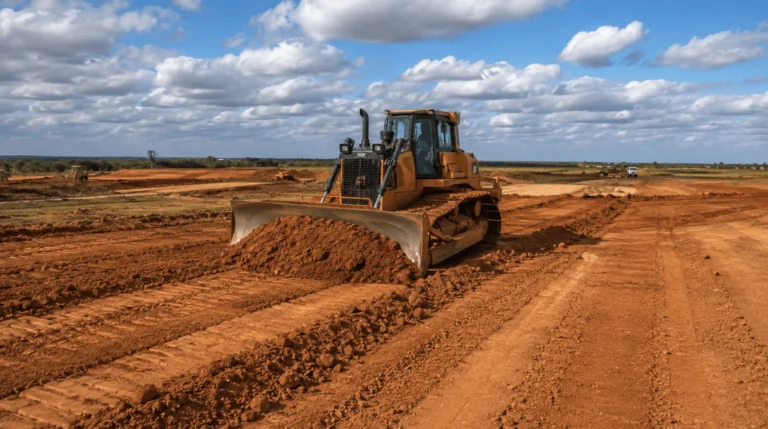
Before a commercial building, warehouse, retail center, multifamily project, roadway, or municipal facility can move forward, the site has to be ready to support everything that comes next. That sounds simple enough until you are standing on raw land in North Texas, looking at uneven grades, clay-heavy soils, drainage challenges, access issues, buried utilities, vegetation, debris, erosion risks, and a project schedule that does not leave much room for mistakes.
That is why commercial site preparation is one of the most important phases of any construction project.
Site preparation is not just about moving dirt. It is the process of turning land into a stable, accessible, properly graded, construction-ready site. When done correctly, it helps the rest of the project move with fewer delays, fewer surprises, and fewer costly corrections. When it is rushed or poorly planned, problems can show up later in the form of drainage failures, unstable pads, failed compaction, muddy access roads, utility conflicts, change orders, and schedule disruptions.
For developers, general contractors, property owners, and builders across Dallas, Fort Worth, Frisco, McKinney, Prosper, Irving, Arlington, Plano, Denton, and the surrounding North Texas region, the right site preparation partner matters. At IRONWILL Earthworks, we help prepare commercial sites with the planning, precision, communication, and field experience needed to get the project started the right way.
If you are preparing land for construction, this commercial site preparation checklist will help you understand what needs to happen before the next trade arrives.
What Is Commercial Site Preparation?
Commercial site preparation is the work required to make a piece of land ready for construction. Depending on the site, that may include site analysis, clearing, stripping, demolition, erosion control, rough grading, mass grading, drainage planning, soil balancing, moisture conditioning, compaction, building pad preparation, paving subgrade preparation, haul-off, and coordination with other civil trades.
In other words, commercial site preparation is the bridge between design and construction. It takes the plans on paper and begins shaping the land so the building, parking lot, utilities, access points, drainage systems, and surrounding improvements can be built correctly.
For North Texas projects, site preparation often requires extra attention to soil conditions, drainage patterns, weather, elevation changes, and municipal requirements. A site in Dallas may have very different access constraints than a large tract in Prosper. A redevelopment site in Irving may come with old pavement, existing utilities, or demolition needs. A commercial pad in Frisco may require tight coordination with paving, utilities, erosion control, and inspection schedules.
That is why the first step is not simply sending equipment to the jobsite. The first step is understanding the land.
Ready to evaluate your site before dirt starts moving? Contact IRONWILL Earthworks to discuss commercial site preparation for your North Texas project.
Step One: Start With Site Analysis Before Moving Dirt
Every successful site preparation project begins with a clear understanding of existing conditions. Before clearing, grading, or excavation begins, the site should be evaluated for slope, drainage, soil behavior, access limitations, utility conflicts, existing structures, vegetation, and any obvious constraints that could affect construction.
This is where early site analysis becomes valuable. A good field review can identify problems that may not be obvious from a plan set alone. Low areas may hold water. Existing grades may not match assumptions. Access for heavy equipment may be tighter than expected. Soil may need additional conditioning or stabilization. Existing concrete, asphalt, or debris may need to be removed before grading can begin.
For commercial projects, this early analysis can help reduce rework. It gives the project team a better understanding of what the land actually requires and helps align the earthwork scope with the overall construction schedule.
IRONWILL provides site analysis services that help contractors, developers, and project managers understand the condition of the land before excavation and grading begin. That insight supports better planning, cleaner scopes, and smoother execution in the field.
A strong site analysis should consider:
- Existing elevations and proposed design grades
- Surface drainage patterns and low points
- Access routes for equipment, trucks, and materials
- Existing structures, pavement, trees, or debris
- Utility conflicts or areas requiring coordination
- Soil conditions that may affect grading, compaction, or pad readiness
- Erosion risks and stormwater considerations
The goal is simple: know what you are working with before the schedule depends on it.
Step Two: Confirm the Scope of Work Before Mobilization
A commercial site preparation project can include many moving pieces, and not every contractor defines the scope the same way. Before mobilization, the owner, GC, civil engineer, and earthwork contractor should have a clear understanding of who is responsible for each part of the site prep process.
This is especially important because scope gaps are one of the easiest ways for a project to lose time and money. If clearing is included but haul-off is not, someone will have to deal with that later. If erosion control is assumed but not actually assigned, the site may not be ready for inspection. If unsuitable soil is encountered but no plan exists for handling it, the schedule can stall while decisions are made.
Before work begins, the site prep scope should be reviewed in detail. Does the project require clearing? Is selective demolition needed? Will topsoil be stripped and stockpiled? Is mass grading included? Who is responsible for pad prep, paving subgrade preparation, moisture conditioning, stabilization, or import/export? Are there density requirements? Are there geotechnical recommendations that affect the work?
IRONWILL’s earthwork services include multiple phases of commercial site preparation, from land clearing and erosion control to mass grading, pad preparation, paving subgrade preparation, and construction management. Having these services coordinated by an experienced earthwork team helps reduce confusion and keeps the project moving from one phase to the next.
A clear scope does more than protect the budget. It protects the schedule.
Step Three: Clear the Site and Remove What Does Not Belong
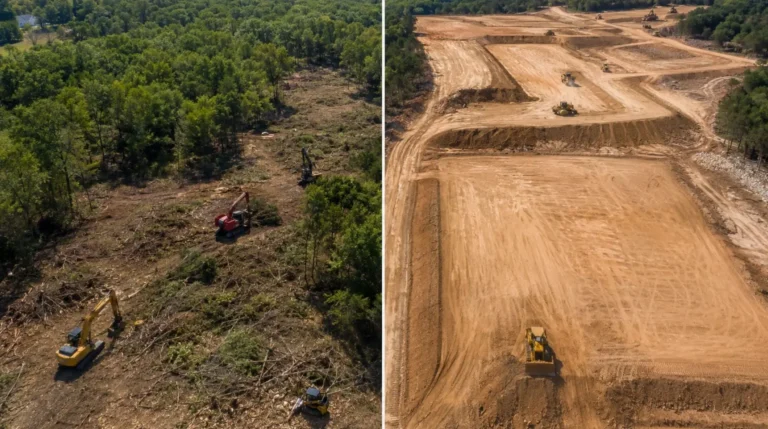
Once the plan is clear, the physical preparation can begin. For many commercial sites, that starts with clearing and stripping.
Land clearing may include removing trees, brush, vegetation, stumps, surface debris, and other obstructions that prevent grading or construction access. On redevelopment sites, it may also involve removing existing pavement, curbs, flatwork, small structures, or other site features that need to be cleared before new construction can begin.
This phase is about more than making the property look open. It creates access for equipment, exposes existing conditions, and allows the team to begin shaping the site according to the civil plans. It also helps identify hidden issues, such as buried debris, soft areas, old utility remnants, or drainage problems that were not visible before clearing.
For North Texas commercial sites, clearing should be handled carefully. Some properties require selective clearing to preserve certain trees, protect neighboring improvements, or maintain required buffers. Others require more complete clearing to prepare for mass grading and pad construction.
If your project involves raw land, redevelopment, or a site with heavy vegetation, it may be helpful to review the difference between clearing and excavation. IRONWILL’s guide on land clearing vs. excavation explains how these early stages work together to prepare land for construction.
Step Four: Plan for Erosion Control and Stormwater Early
Erosion control should not be treated as an afterthought. Once soil is disturbed, the site becomes more vulnerable to runoff, sediment movement, muddy conditions, and compliance issues. For commercial projects, erosion control and stormwater planning should be addressed before major grading begins.
North Texas construction sites can be especially challenging because heavy rain can quickly turn an unprotected site into a muddy, unstable work area. Poor erosion control can affect surrounding properties, storm drains, creeks, streets, and downstream infrastructure. It can also slow down work when crews are forced to repair washed-out areas, regrade slopes, clean access points, or wait for conditions to dry out.
A good site preparation plan considers erosion control early. Silt fencing, construction entrances, inlet protection, stabilized access points, temporary drainage paths, and other measures may be needed depending on the project. The exact requirements will depend on the site, the jurisdiction, the size of the disturbed area, and the project’s stormwater obligations.
IRONWILL provides erosion control as part of its site development services, helping protect the site from soil loss and runoff while supporting project stability and compliance.
For developers and GCs, the key is to coordinate erosion control with the grading plan. The site should not only be shaped for the finished project. It should also be managed during construction so water has a controlled path and exposed soil does not create avoidable problems.
Need help coordinating clearing, grading, erosion control, and pad prep? Talk with IRONWILL Earthworks before your North Texas site prep project begins.
Step Five: Rough Grade the Site for Drainage, Access, and Buildability
Rough grading is where the site begins to take shape. This phase adjusts the land’s elevations so the property can support the proposed building, parking areas, drives, drainage features, utilities, and surrounding improvements.
For commercial construction, grading has to do several things at once. It must create usable building areas, establish positive drainage, support access for construction traffic, and coordinate with the planned finished elevations. If the rough grading is off, the problems can ripple through the entire project.
In North Texas, grading must also account for soil behavior and water movement. Clay-heavy soils can hold moisture, become difficult to work when wet, and create challenges when the site does not drain properly. That makes grading strategy especially important. Water should move away from building pads, pavement areas, and active work zones in a controlled way.
This is where local experience matters. A contractor who understands North Texas site conditions will not treat grading as simply “making it level.” Commercial grading is about shaping the site according to the design while keeping the next phases of construction in mind.
IRONWILL’s mass grading services are built around accuracy, drainage awareness, and coordination with partner trades. That coordination is important because utilities, paving, building pads, and site access all depend on the earthwork being performed correctly.
Step Six: Balance Cut and Fill Whenever Possible
One of the biggest cost factors in commercial earthwork is how much material must be moved, imported, exported, or reused on site. A well-planned cut-and-fill strategy can reduce unnecessary trucking, limit haul-off, and help keep the project more efficient.
Cut refers to soil removed from higher areas of the site. Fill refers to soil placed in lower areas to bring them up to the required elevation. When the site is properly analyzed and graded, usable material may be balanced across the property to reduce the need for outside import or disposal.
That said, not all soil is suitable for structural fill. Some material may be too wet, too organic, too unstable, or otherwise unsuitable for placement under building pads, paving, or structural areas. In those cases, the project may require removal, replacement, stabilization, or moisture conditioning.
This is why cut-and-fill planning should be tied to the geotechnical recommendations, civil plans, and field conditions. It is not just a math exercise. It is a construction decision that affects cost, schedule, compaction, and long-term performance.
A good commercial site preparation contractor will look for ways to make the earthwork efficient without compromising the integrity of the finished site.
Step Seven: Prepare Building Pads for Construction
Building pad preparation is one of the most important parts of commercial site prep. The building pad is the prepared area that will support the structure, so it needs to be built with the right material, moisture, compaction, elevation, and drainage considerations.
Pad preparation may involve cutting or filling to design elevation, removing unsuitable material, placing approved fill, moisture conditioning, compacting in lifts, and preparing the surface according to geotechnical and project requirements. Depending on the design, stabilization methods or aggregate import may also be required.
For commercial projects, pad readiness is about more than appearance. A pad can look flat and still fail to meet density or moisture requirements. It can be smooth but still hold water in the wrong places. It can be close to grade but not ready for forms, foundations, or the next trade.
IRONWILL provides pad preparation following geotechnical guidelines, including moisture conditioning, aggregate placement, and stabilization methods when required. That level of detail helps ensure the building area is ready for the next phase of construction.
Before calling a pad ready, the project team should confirm:
- Finished subgrade elevation
- Required compaction and density testing
- Moisture condition of the soil
- Drainage away from the pad area
- Stability of the prepared surface
- Access for concrete, foundation, utility, or framing crews
- Compliance with geotechnical and civil requirements
This is one section where a checklist is worth taking seriously. Once vertical construction begins, correcting pad problems becomes much more expensive.
Step Eight: Prepare Paving Subgrades and Access Areas
Commercial site preparation does not stop at the building pad. Parking lots, drives, fire lanes, loading areas, sidewalks, and access roads also depend on properly prepared subgrades.
A weak paving subgrade can create long-term issues with pavement performance. Poor drainage, unstable material, soft spots, or insufficient preparation can affect how the finished surface holds up over time. On commercial sites with truck traffic, delivery routes, dumpsters, loading docks, or emergency access lanes, subgrade preparation becomes even more important.
Paving subgrade preparation may include grading, proof rolling, moisture conditioning, stabilization, aggregate placement, and coordination with the paving contractor. This work should follow the civil plans, geotechnical recommendations, and project specifications.
IRONWILL provides paving subgrade preparation using methods such as aggregate import, flex base, cement slurry stabilization, lime stabilization, fly ash, and CKD when appropriate for the project. That gives commercial sites the support they need before pavement is placed.
For developers and GCs, this phase is another reason to bring the earthwork contractor into planning early. The better the coordination between grading, utilities, drainage, and paving, the fewer problems show up when the paving contractor is ready to mobilize.
Step Nine: Coordinate With Utilities, Paving, and Other Civil Trades
Commercial site preparation is rarely isolated from the rest of the construction process. Earthwork affects utilities. Utilities affect paving. Drainage affects grading. Grading affects building pads. Access affects everyone.
That is why coordination is one of the most valuable parts of a successful site prep project.
If utilities are not considered early, trenches may conflict with prepared areas or require rework. If paving subgrade is prepared before utility coordination is complete, the site may need to be disturbed again. If drainage patterns are not understood, temporary site conditions can create problems for multiple trades.
IRONWILL’s approach to commercial and civil construction markets is built around supporting developers, commercial builders, industrial projects, municipal work, residential developments, and infrastructure needs with precision and efficiency. For commercial projects, that means looking beyond the dirt and understanding how the site preparation phase connects to everything that follows.
A site preparation contractor should communicate clearly with the GC, civil engineer, testing lab, inspectors, utility contractors, paving teams, and other key stakeholders. The goal is to reduce rework, prevent scope gaps, and keep the construction sequence moving.
Step Ten: Keep the Site Clean, Safe, and Ready for the Next Phase
A prepared site should not just be graded. It should be organized, accessible, and safe for the next phase of construction.
That means maintaining construction entrances, controlling mud, keeping haul routes workable, managing stockpiles, maintaining erosion control measures, and leaving the site in a condition that allows the next trade to work efficiently. A messy or unstable site can create delays even after the primary grading work is complete.
Clean site management also reflects professionalism. It helps reduce confusion, improves access, supports safety, and gives project managers more confidence that the site is being handled with discipline.
At IRONWILL Earthworks, site preparation is approached as part of the larger construction process. The goal is not just to finish one scope. The goal is to prepare the site so the entire project can move forward with confidence.
Why North Texas Site Preparation Requires Local Experience
Commercial site preparation in North Texas comes with its own set of challenges. The region includes dense urban infill sites, fast-growing suburban developments, large commercial tracts, industrial properties, municipal projects, and residential communities. Sites across Dallas-Fort Worth can vary widely in soil conditions, drainage behavior, access limitations, and local permitting requirements.
Clay-heavy soils are a major consideration throughout much of the region. When moisture changes, these soils can become difficult to manage. Wet conditions can slow grading and compaction. Dry conditions can affect moisture conditioning. Poor drainage can leave parts of the site unstable or unworkable.
Weather is another factor. North Texas storms can quickly impact exposed soil, temporary access roads, stockpiles, and active grading areas. Heat, drought, and sudden rainfall can all affect how earthwork is scheduled and performed.
Local experience helps contractors anticipate these conditions instead of reacting to them after they become problems. It also helps the project team make better decisions about grading, drainage, stabilization, compaction, and sequencing.
IRONWILL Earthworks is rooted in DFW and serves commercial, industrial, municipal, multifamily, residential, and infrastructure projects across North Texas. Whether the project is in Dallas, Fort Worth, Frisco, McKinney, Prosper, Irving, Arlington, Plano, Denton, or the surrounding communities, our team understands that the ground conditions are never just a detail. They are the foundation of the project.
Commercial Site Preparation Checklist
Use this checklist as a practical starting point before your next commercial site preparation project begins.
Pre-Construction Review
Confirm that the civil plans, grading plans, geotechnical report, erosion control requirements, site access points, utility plans, and construction schedule have been reviewed before mobilization. The earthwork scope should be clearly defined so all parties understand what is included, what is excluded, and what needs additional coordination.
Site Analysis
Evaluate existing grades, drainage patterns, soil conditions, access constraints, existing structures, vegetation, debris, and potential utility conflicts. A strong site analysis helps prevent surprises before equipment is on site.
Clearing and Stripping
Remove vegetation, trees, stumps, surface debris, unsuitable organic material, existing pavement, or structures as required by the scope. Confirm whether materials will be hauled off, recycled, stockpiled, or reused.
Erosion Control and Stormwater
Install and maintain erosion control measures before major soil disturbance. Confirm stormwater requirements, construction entrances, sediment controls, inlet protection, and temporary drainage needs.
Rough Grading and Mass Grading
Shape the site according to proposed elevations, drainage needs, building pads, parking areas, access drives, and future utility work. Coordinate grading with the civil plans and construction sequence.
Cut, Fill, and Soil Management
Balance usable onsite material where possible. Identify unsuitable material, import/export needs, moisture conditioning requirements, stabilization needs, and compaction expectations.
Building Pad Preparation
Prepare building pads according to geotechnical and project specifications. Confirm elevation, moisture, compaction, stability, drainage, and readiness for the next trade.
Paving Subgrade Preparation
Prepare parking lots, drives, fire lanes, loading areas, and access routes according to specifications. Address soft spots, stabilization requirements, aggregate placement, and coordination with paving teams.
Utility and Trade Coordination
Coordinate with utility contractors, paving contractors, testing labs, inspectors, engineers, and the GC to reduce rework and protect the schedule.
Final Review
Before turning the site over to the next phase, confirm that access is maintained, erosion control is functioning, grades are correct, pads are ready, and the site is clean, safe, and workable.
When Should You Bring in a Site Preparation Contractor
The best time to involve a commercial site preparation contractor is before the project is already under pressure.
Bringing in an earthwork team early can help identify potential scope gaps, evaluate construction access, review cut-and-fill assumptions, plan erosion control, understand soil challenges, and coordinate the sequence of work. This is especially useful for developers and GCs working with aggressive schedules or complex sites.
If your project involves raw land, redevelopment, commercial pad construction, industrial facilities, multifamily development, municipal work, or infrastructure improvements, early earthwork input can help the project team make better decisions before those decisions become expensive.
IRONWILL provides site preparation and earthwork services for clients across North Texas. From conceptual planning through construction, our team helps prepare the ground with precision, communication, and the kind of field experience that keeps projects moving.
Ready to Prepare Your Commercial Site in North Texas?
Commercial construction starts long before the first wall goes up. It starts with the ground.
A well-prepared site gives the entire project a stronger foundation. It helps manage drainage, supports building pads and paving areas, reduces rework, improves coordination, and creates a cleaner path from design to construction.
If you are planning a commercial, industrial, multifamily, municipal, residential development, or infrastructure project in North Texas, IRONWILL Earthworks is ready to help.
Contact IRONWILL Earthworks today to discuss your commercial site preparation needs, request a consultation, or review your upcoming project.