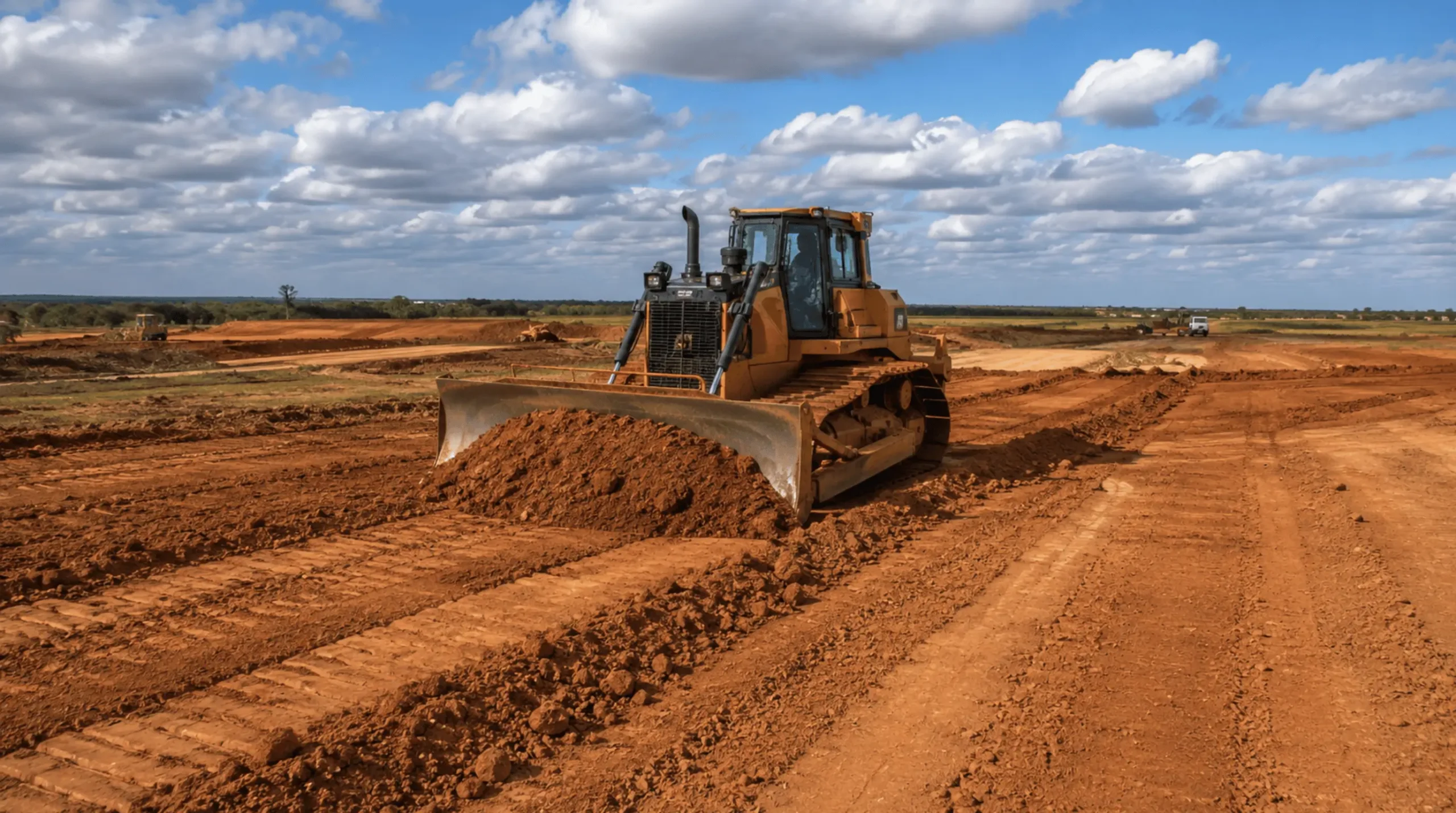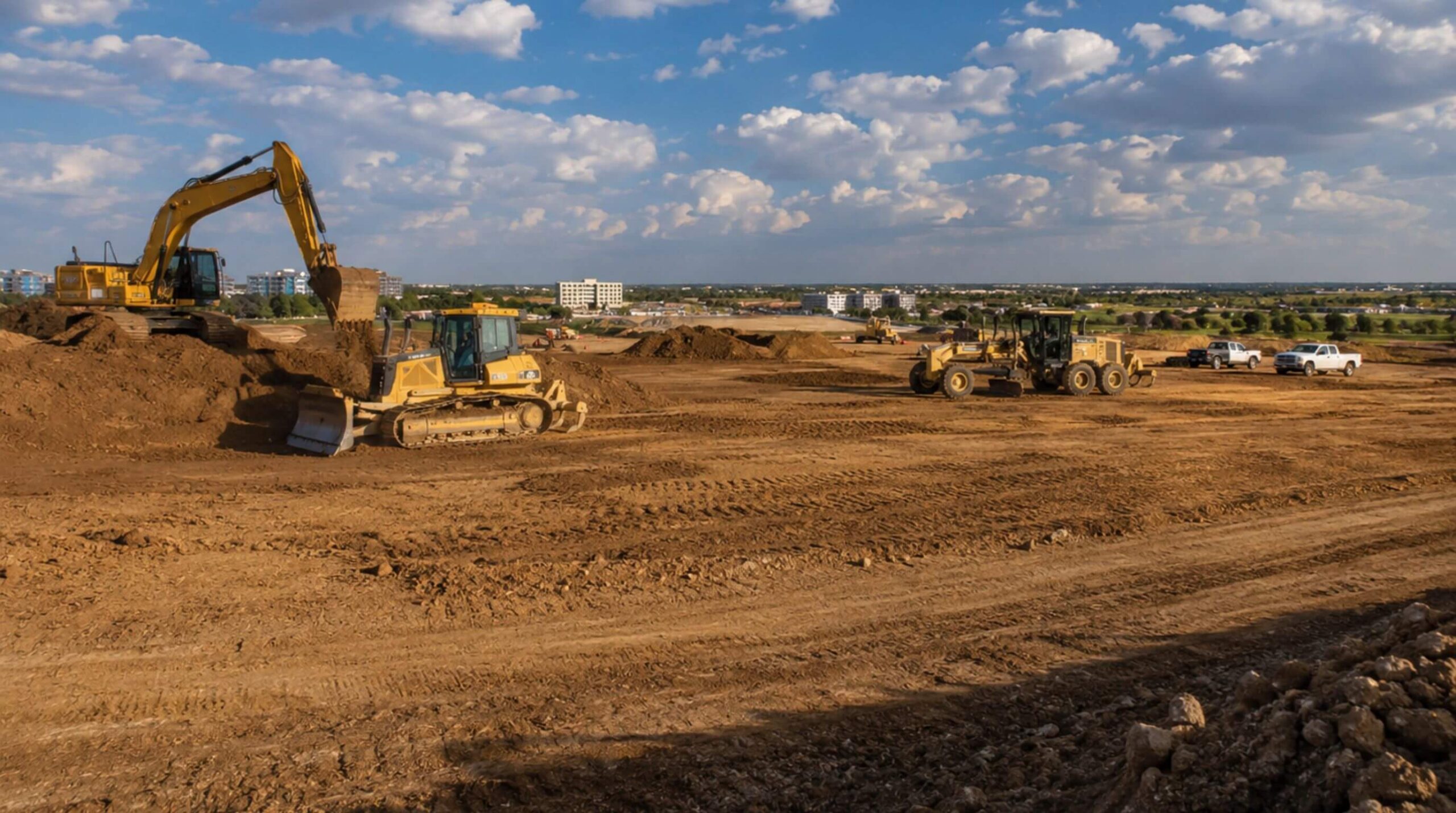

Ask five people on a job site to define land clearing and excavation and you will get five answers that are all roughly right. Clearing takes things off the land. Excavation moves the land itself. Nobody argues about that. The argument, when it comes, is never about the definition. It is about where one scope stopped and the other started, who was supposed to take the stumps out below the fill, and why the cleared acreage on the invoice does not match the cubic yards on the plan.
There is a better place to settle it than a conversation on the tailgate. Texas pays for this work through a set of specification items, and those items define each scope, say how far down it goes, and state the unit it is measured in. Read them side by side and the difference between clearing and excavation stops being a matter of description. It becomes a matter of dimension: one scope is paid for by the ground you cross, the other by the volume you move.
The two scopes, in the specification's own words
Preparing right of way, Item 100 in the state's 2024 standard specifications, is the clearing item. Its stated job is to prepare the right of way and designated easements for construction by removing and disposing of all obstructions, where their removal is not shown on the plans to be paid under some other item1. The obstructions it names are almost everything a site can carry that is not soil: building remains, foundations, floor slabs, concrete, brick, lumber, septic drain fields, basements, abandoned utility pipe, equipment, fences, retaining walls, curb and gutter, paved parking, sidewalks, drainage structures, manholes, inlets, abandoned railroad track, scrap iron and debris, above ground or below it1. One exclusion in that list matters more than the rest: removal of live utility facilities is not part of the item1.
Excavation, Item 110, is written in one sentence: excavate the areas shown on the plans, and remove the materials encountered to the lines, grades and typical sections the plans and cross sections show1. Everything else in the item is about what happens to the surface you leave behind. Maintain drainage in the cut so the roadway section is not damaged. Shape slopes without loosening material below or outside the proposed grades. Scarify at least six inches below plan grade where a pavement structure is going, then compact1. The clearing item is a list of things to take away. The excavation item is a set of surfaces to arrive at.
The difference is a dimension
Here is the part that decides bids. Item 100 is measured by the acre, by the 100 foot station regardless of how wide the right of way is, or by each tree removed1. Item 110 is measured by the cubic yard in its original position, computed by the method of average end areas1. Clearing is a two dimensional measurement taken across a surface. Excavation is a three dimensional measurement taken through a solid. No amount of care in one number tells you anything about the other.
| Land clearing | Excavation | |
|---|---|---|
| Pay item | Item 100, Preparing Right of Way; tree and brush work performed under Item 7521 | Item 110, Excavation1 |
| What it removes | Obstructions: vegetation, stumps, slabs, foundations, fences, walls, abandoned pipe, debris, above or below ground1 | Soil and rock, to the lines, grades and typical sections on the plans1 |
| Where it stops | A specified depth below existing ground, set by what the plan does there1 | Plan grade, plus a scarified and recompacted zone under pavement1 |
| Unit of measure | The acre, the 100 foot station, or each tree1 | The cubic yard in its original position, by average end areas1 |
| How a tree is counted | By diameter measured 3 feet above the ground; under 4 inches is brush, and multi trunk trees are measured separately1 | Not applicable |
| Acceptance | Obstructions gone to the specified depth, holes backfilled, disposal off site and lawful1 | Grade within 1.25 inches in the cross section and in 16 feet longitudinally on staged work, 0.5 inch on turnkey work1 |
| Released by | The tree ordinance and the biological calendar56 | A one call notice, and the located utilities that come back with it43 |
The acceptance row is worth reading twice. Clearing is finished when things are absent. Excavation is finished when a surface is within a tolerance you can measure with a rod, and on turnkey work that tolerance is half an inch1. Those are not the same kind of completion, they are not proved with the same instrument, and they do not fail in the same way.
The items in between, and why "clear and grub" is not one number
Most commercial sites are not raw pasture. They carry slabs, pavement, curb and old structures, and the specification pays for those under items of their own rather than under either clearing or excavation, in units that change with the object being removed. Concrete comes off by area or by volume; curb is taken by length and a wall by the area of its face; existing base and asphalt can be taken by station, by area or by volume depending on what the plans show1. That is four different dimensions on what a proposal might call one demolition line. Tree work adds a fifth, and it is a count: each tree is paid by the diameter specified, measured three feet above the ground, with anything under four inches classed as brush and trimming and brush removal measured by the centerline mile1.
So a site that reads on a drone photo as one clearing operation can be five pay items in four units. When a proposal collapses all of it into a single lump sum for clearing and grubbing, the two quantities with the most risk in them, the concrete volume and the grubbing depth, are the two the number is least able to carry.
Where clearing stops is set by the grading plan
The cleanest proof that these scopes are coupled sits in the depth rules. Item 100 requires obstructions not designated for preservation to be removed to two feet below natural ground in areas that will receive embankment, to two feet below the excavation level in areas that will be excavated, and to one foot below natural ground everywhere else, with trees and stumps taken to six inches below ground level1.
Read that as an estimator. The depth the clearing crew has to reach at any given point on the site depends on whether the grading plan puts fill there, cut there, or nothing there. The same stump is a one foot removal, a two foot removal, or a removal referenced to an excavation surface that does not exist yet, depending on a drawing that has nothing to do with vegetation. Clearing cannot be quantified from a site walk and an aerial. It takes the grading plan, which is why we ask for the civil set before quoting a clearing scope and not after.
The sequence is a requirement too, not a convention. The embankment item instructs the contractor to complete preparation of the right of way in accordance with Item 100 for areas that are going to receive embankment, and to backfill stump holes and other minor excavations with approved material and tamp them1. Embankment material itself has to be free of vegetation or other objectionable material1. Federal safety rule says the same thing from the other direction: all surface encumbrances located so as to create a hazard shall be removed or supported before the work goes ahead3. Fill placed over organic material that was left in the ground settles later, on somebody else's schedule, and no compaction test taken on the lift above it will say so.
Two scopes, two clocks
The scopes are also released by different rules, which is the practical reason they cannot simply be run together to save a mobilization.
Clearing answers to biology and to local ordinance. Federal law makes it unlawful to take protected migratory birds without authorization, take being defined to include killing and capturing, under 16 U.S.C. 703 through 7125, so vegetation removal in the nesting season has to be planned around active nests rather than discovered by a mulcher. Oaks add a second window: Texas A&M Forest Service advises against pruning or wounding oaks from February through June, because the sap beetles that carry the oak wilt fungus are most active in late winter and spring, and recommends that oak wounds be painted immediately whatever the time of year6. If the cleared material is burned rather than ground, the state's outdoor burning rules set the hours and the setbacks: begin at least an hour after sunrise, stop at least an hour before sunset the same day, keep the fire downwind of or at least 300 feet from a neighboring occupied structure, never let it burn across a road, and keep a responsible party present while it is active7.
Excavation answers to what is underground. In Texas an excavator must notify a notification center not earlier than the fourteenth day before the excavation is to begin and not later than the forty eighth hour before it begins, excluding Saturdays, Sundays and legal holidays4. Federal rule requires the estimated location of utility installations to be determined before an excavation is opened, and the utility owners to be contacted and asked to establish those locations before actual excavation starts3. None of that attaches to taking a fence line down. All of it attaches the moment a bucket goes into the ground.
One scope is legally "development" and the other is not
The asymmetry runs into the permit world as well, in a way that catches people out on floodplain sites. The National Flood Insurance Program defines development as any man made change to improved or unimproved real estate, and the list it gives includes buildings and other structures, mining, dredging, filling, grading, paving, excavation and drilling operations, and the storage of equipment or materials2. Filling, grading and excavation are named. Clearing is not. On a site with mapped flood hazard, the permit trigger tends to attach to the earthmoving rather than to the vegetation.
It runs the other way too. Where a creek, a pond or a wetland on the property is a water of the United States, as defined at 33 CFR 328.38, clearing inside that feature can require a federal authorization even though the work removes vegetation and moves no soil off site at all. Each scope has a rule that does not apply to the other, which is a good reason to know which one you are buying.
Why both, and in that order
Nearly every commercial site needs both scopes, and the order is not negotiable. Until the ground is cleared, nobody can see it: the surveyor cannot shoot existing grade through brush, the geotechnical engineer's rig cannot reach half the boring locations, and the takeoff that sets the excavation quantity is being computed against a surface that is partly guesswork. Clear first and the site becomes measurable. Then the volume work begins, against a surface everyone agrees on.
There is a safety dimension to keeping them distinct as well. Site clearing has its own federal standard: workers engaged in it must be protected from irritant and toxic plants and instructed in the first aid available, and equipment used in clearing must carry rollover guards, with rider operated machines also carrying overhead and rear canopy guards built to a specified plate thickness and mesh9. That is a different set of controls from the ones that govern an open cut, on different machines, briefed differently. Treating the two scopes as one operation tends to mean one of those briefings does not happen.
IRONWILL Earthworks self performs both. We clear and grub to the depth the grading plan calls for at each location, dispose of or grind what comes off, backfill and tamp the stump holes, and hand the surveyor a site that can be shot. Then we cut and fill it to the elevations on the plans. Send us the civil set and the geotechnical report and we will tell you which acreage is clearing, which volume is excavation, and where on your site the line between them falls.
IRONWILL Earthworks self-performs this work for general contractors, developers and public owners across Texas and Oklahoma: see Land Clearing and Excavation, or request a bid.