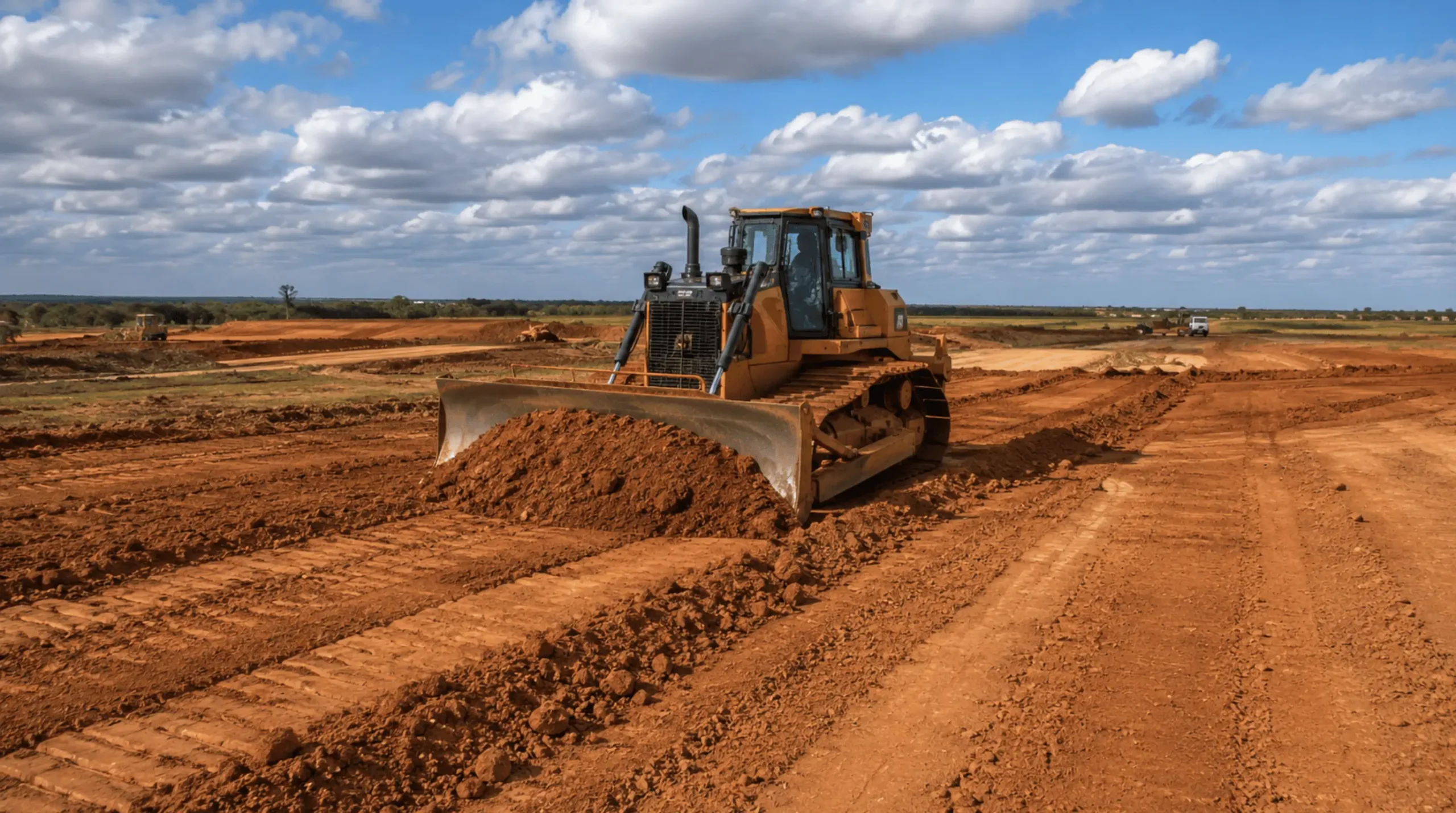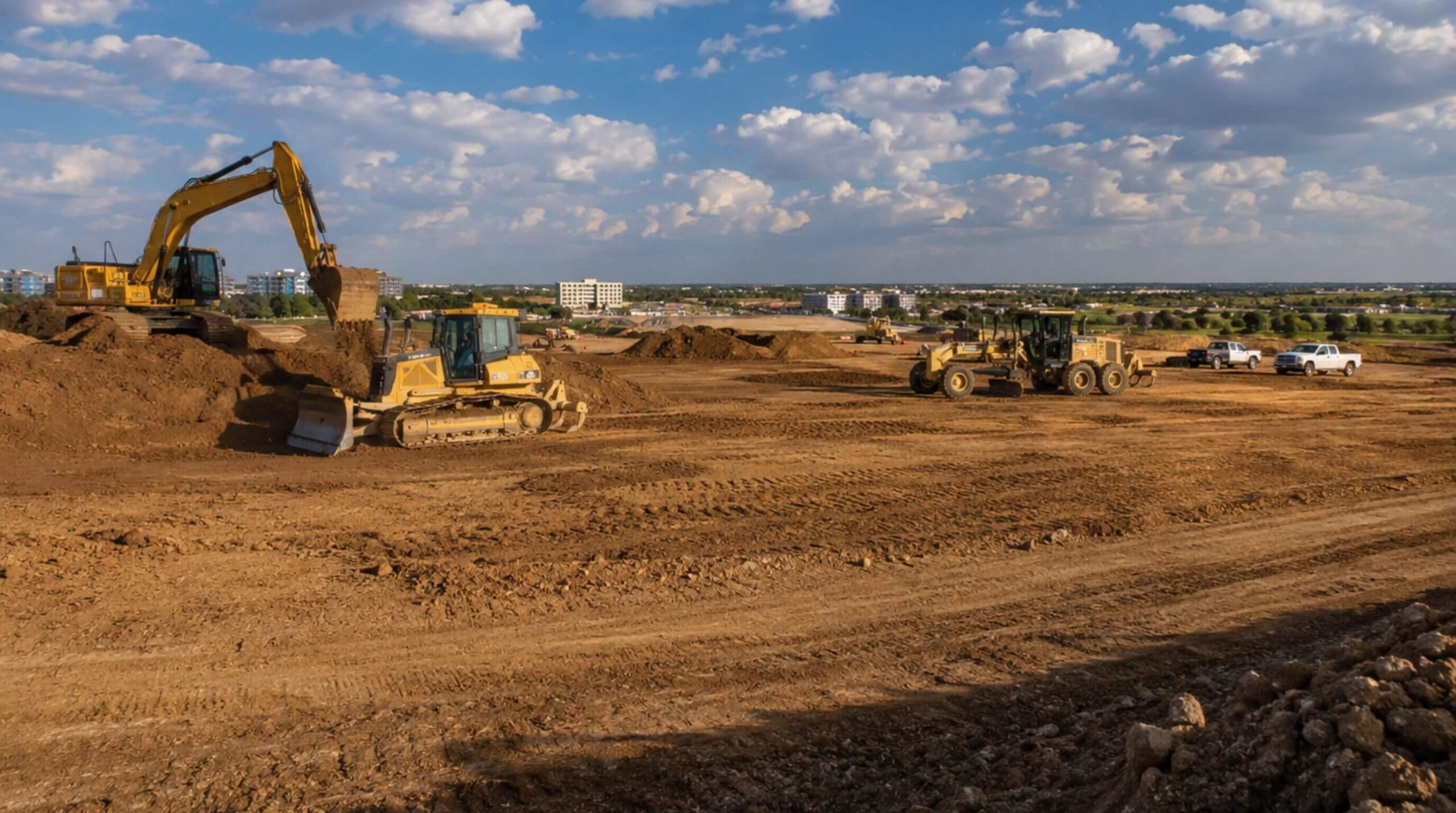

Earthwork is the part of construction that changes the ground itself: cutting it down where it is high, building it up where it is low, and compacting what is placed so that it carries whatever comes next. It is the oldest trade on a site and the one with the least visible product, because a finished grade looks like a field. What separates it from moving dirt is that every cubic yard is defined, measured, classified, placed and tested against a written standard. This primer walks those standards in the order a project meets them, so that the words on a bid tab, a boring log and a density report mean the same thing to the owner, the engineer and the crew.
The two halves: excavation and embankment
Public specifications split earthwork into two pay items, and the split is the clearest definition of the trade there is. Excavation is removing material to the lines, grades and sections on the plans; embankment is furnishing, placing and compacting material where the design needs more ground than exists. The Texas Department of Transportation's 2024 standard specification for excavation reads, in full, "Excavate areas as shown on the plans or as directed. Remove materials encountered to the lines, grades, and typical sections shown on the plans and cross-sections," and it makes the contractor the owner of what comes out: unsuitable or excess material is disposed of outside the right of way in conformance with local, state and federal regulations1. The embankment item is its mirror: "Furnish, place, and compact materials for construction of roadways, embankments, levees, dikes, or any designated section of the roadway where additional material is required"2.
Federal safety rules define the cut itself even more plainly. An excavation, in OSHA's construction standard, is a man-made cut, cavity or depression in an earth surface formed by earth removal, and the person responsible for it is a competent person: one who is capable of identifying existing and predictable hazards and who has authorization to take prompt corrective measures to eliminate them3. Every open cut on a site has one, by name.
Between those two halves sits everything the trade is known for: clearing and grubbing, stripping topsoil, mass grading, building pads, subgrade, slopes, swales and basins. Each is a combination of the same two operations, cut and fill, governed by the same measurements.
How earthwork is measured, and why the dirt does not add up
Excavation is measured by the cubic yard in its original position, computed by the method of average end areas from the cross-sections, and on a public job it is a plans-quantity item: the quantity paid is the quantity in the proposal unless the plans change1. The same specification adds a sentence that explains most earthwork disputes: "Shrinkage or swelling factors will not be considered in determining the calculated quantities"1. The engineer measures the hole. The contractor has to live with the fact that the dirt from the hole does not fit back into it.
A cubic yard of ground occupies three different volumes during a job. In place, undisturbed, it is a bank yard. Dug and loaded, it swells into a larger loose yard. Placed and compacted, it shrinks, usually to less than it was in the bank. A state transportation research report describes the cycle as generally positive volume change after excavation from the bank state to the loose state, called expansion or swell, and generally negative change from the bank state to the compacted state, called shrinkage, and it attributes most earthwork estimating errors to improper use of, or uncertainty in, the factors that convert between the three4. The report's literature review compiles the factors the industry uses. The table below is drawn from the set it attributes to the Federal Highway Administration.
| Material | Loose swell | Embankment change |
|---|---|---|
| Clay, dry | 50 percent | Shrinks 10 percent4 |
| Clay, damp | 67 percent | Shrinks 10 percent4 |
| Earth or loam, dry | 50 percent | Shrinks 12 percent4 |
| Earth or loam, damp | 43 percent | Shrinks 4 percent4 |
| Sand, dry | 11 percent | Shrinks 11 percent4 |
| Topsoil | 56 percent | Shrinks 26 percent4 |
| Limestone | 63 percent | Swells 36 percent4 |
| Shale | 79 percent | Swells 49 percent4 |
| Sandstone | 61 percent | Swells 34 percent4 |
Two things in that table decide the economics of a North Texas site. Clay shrinks about a tenth from bank to fill, so a site that balances on paper is short of dirt in the field. And broken rock swells by a third or more and never goes back, so a cut into the chalk that underlies much of Dallas County produces more material than the hole it came from, and the surplus has to go somewhere. The same report notes that published factors carry an average variation of about a third for both rock and earth materials4, which is why a bid built on a factor from a table is an estimate and a bid built on the project's own geotechnical report is a number.
What the dirt is: the Unified Soil Classification System
Before any of it is moved, the soil is classified, and the trade's common language for that is the Unified Soil Classification System, ASTM D2487. It classifies mineral soils for engineering purposes from the laboratory determination of particle size, liquid limit and plasticity index5. The first cut is grain size: a soil is fine-grained if it contains 50 percent or more fines, the particles that pass the No. 200 sieve, whose opening is 0.075 millimeters, and coarse-grained if it contains less6. Coarse soils are then gravels or sands, graded well or poorly, with silt or clay fines. Fine soils are sorted by plasticity: the system plots liquid limit against plasticity index, and a liquid limit of 50 is the boundary between low and high plasticity5.
| Symbol | Group name | Symbol | Group name |
|---|---|---|---|
| GW | Well graded gravel6 | CL | Lean clay6 |
| GP | Poorly graded gravel6 | ML | Silt6 |
| GM | Silty gravel6 | OL | Organic clay or organic silt, low plasticity6 |
| GC | Clayey gravel6 | CH | Fat clay6 |
| SW | Well graded sand6 | MH | Elastic silt6 |
| SP | Poorly graded sand6 | OH | Organic clay or organic silt, high plasticity6 |
| SM | Silty sand6 | PT | Peat6 |
| SC | Clayey sand6 |
The two letters that matter most on a Blackland site are CH. Fat clay is the soil that swells, and the plasticity index that sorts it there is the same number that decides how it is compacted and whether it can be used as fill at all. The Atterberg limits behind that index are measured by ASTM D4318, whose own scope says the limits correlate with compressibility, permeability, compactibility, shrink-swell and shear strength7. TxDOT's embankment item turns the number into a material rule: its Type A granular embankment must have a liquid limit of 45 or less and a plasticity index of 15 or less, while Type B is the catch-all of rock, loam, clay or other approved materials2. On a private job the geotechnical report plays the same role, naming which of the site's soils may be reused as structural fill.
Compaction: the two Proctor efforts
Fill is not placed; it is placed and compacted, and compaction is specified against a laboratory curve. The curve comes from one of two ASTM tests that differ only in how hard the soil is hit. The standard effort test, ASTM D698, compacts the soil in three layers with a 5.5-pound rammer dropped 12 inches, for a total effort of 12,400 foot-pounds per cubic foot, and produces the relationship between water content and dry unit weight from which the maximum dry unit weight and the optimum water content are read8. The modified effort test, ASTM D1557, uses a 10-pound rammer dropped 18 inches on five layers, for 56,000 foot-pounds per cubic foot, more than four times the energy9. Both tests offer three methods, A, B and C, that differ in the mold size and the fraction of soil tested, from material passing the No. 4 sieve in a 4-inch mold to material passing the 3/4-inch sieve in a 6-inch mold89.
| Test | Effort | Rammer and drop | Layers |
|---|---|---|---|
| ASTM D698, standard | 12,400 ft-lbf per cubic foot8 | 5.5 pounds, 12 inches8 | Three8 |
| ASTM D1557, modified | 56,000 ft-lbf per cubic foot9 | 10 pounds, 18 inches9 | Five9 |
The distinction is not academic. A specification that calls for 95 percent of modified Proctor is asking for a denser, drier lift than one that calls for 95 percent of standard, and the same soil at the same field density passes one and fails the other. ASTM's own statement of purpose for the modified test is the reason both exist: laboratory compaction tests provide the basis for determining the percent compaction and molding water content needed to achieve the required engineering properties, and for controlling construction to assure that they are achieved9.
How a lift is passed
Compaction is controlled in the field two ways, and the specification says which. Under ordinary compaction, each layer is rolled with approved equipment, brought to the moisture content directed, and compacted until there is no evidence of further consolidation, with the loose depth of any layer held to 8 inches unless otherwise approved2. Under density and moisture control, each layer is compacted to a required density read against the laboratory curve, the layer is limited to 16 inches loose or 12 inches compacted, and the engineer tests each layer for density and moisture2. The requirement itself moves with the soil's plasticity, which is the single most useful table in the trade for anyone working on clay.
| Soil | Required density (Tex-115-E) | Required moisture |
|---|---|---|
| PI of 15 or less | 98 percent of Da or more2 | Not specified2 |
| PI over 15 to 35 | 98 to 102 percent of Da2 | At or above optimum2 |
| PI over 35 | 95 to 100 percent of Da2 | At or above optimum2 |
Read the bottom two rows carefully, because they contradict the instinct that denser is always better. For plastic clay the specification sets a ceiling on density as well as a floor, and it requires the lift to be placed at or wet of optimum moisture2. A fat clay compacted dry and hard is a lift waiting for its first rain to swell. The same item requires that moisture be maintained no lower than 4 percent below optimum for soils with a plasticity index above 15 once the layer has passed, and that material which loses its density, moisture or finish be reworked2. In the field the density is read with a nuclear gauge under ASTM D6938, which measures in-place density from the attenuation of gamma radiation and water content from the slowing of fast neutrons, to a source depth of up to 12 inches, and is the accepted method for quality control and acceptance of compacted soil10.
Building codes reach the same place from the other direction. Where a shallow foundation will bear on compacted fill, the International Building Code requires the fill to comply with an approved geotechnical report, and it exempts only fill of 12 inches or less, and then only if it is compacted to at least 90 percent of maximum dry density11. There is no such thing as unspecified structural fill.
The tolerances a finished grade is held to
Earthwork ends at a surface, and the surface has a tolerance. The Texas specification holds staged construction to within 1.25 inches in the cross-section and 1.25 inches in 16 feet longitudinally, and turnkey construction to within half an inch on both1. For excavation to subgrade under pavement it also requires the remaining material to be scarified at least 6 inches below grade and recompacted1, because the surface a scraper leaves is not the surface a pavement is designed on. On a commercial site the tolerances come from the civil plans and the geotechnical report, and the surveyor's as-built is the record that the grade met them.
What earthwork is not
The word gets stretched. Earthwork is not the installation of the utilities that run through the ground, which is a separate trade with its own specifications, although the grade has to be left where that trade needs it. It is not paving, although the subgrade under the pavement is earthwork's last product. And it is not landscaping, although the topsoil that was stripped at the start goes back at the end. A clean definition helps a schedule: the earthwork contractor owns the ground from the first cut to the tested subgrade, and every other trade builds on what that contractor has proven.
That is what IRONWILL Earthworks does across Dallas-Fort Worth: the cut, the fill, the classification, the compaction and the record, on ground that is mostly fat clay and sometimes chalk, for owners and general contractors who need the surface under their project to be a number rather than an assumption. Send the plans and the geotechnical report, and we will take off the quantities in bank yards, tell you what they become in the truck and in the fill, and tell you what the lifts will be tested against.